
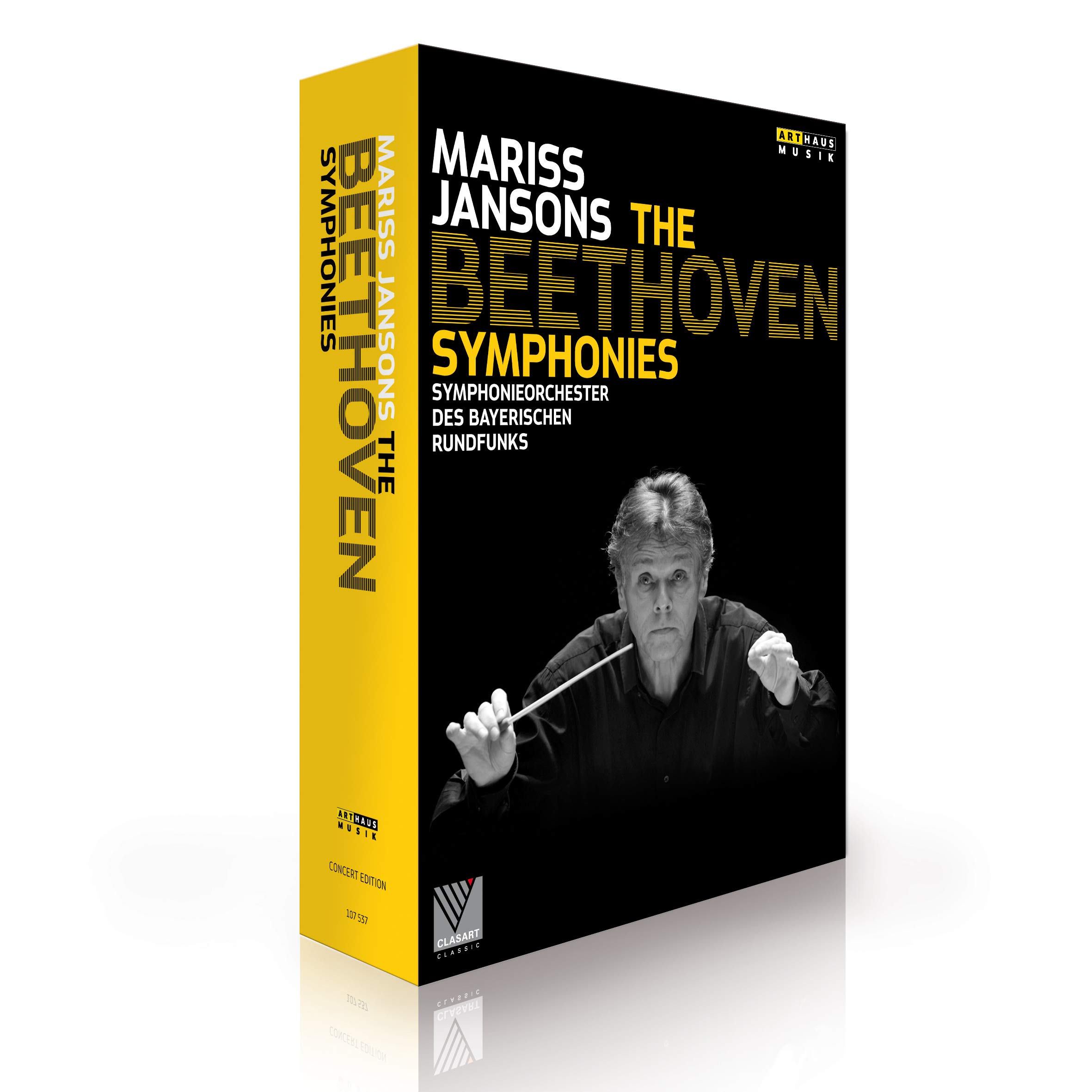
Glorious Beethoven set
In comparison with his earlier Beethoven, it is quite evident that Mariss Jansons has radically re-thought his approach to this symphonic cosmos. The results, captured live in brilliant audio and video (with excellent camera work) in Tokyo’s Suntory Hall in 2012, are magnificent. Jansons combines the best of two worlds in today’s Beethoven interpretation: the transparency, crispness of detail and fleet tempi of the “authentic” school – without the flavor of period instruments which may not be pleasing (yet) to every ear – with the overwhelming “big band” splendor of the “traditionalists”. My benchmarks of cutting-edge readings are Norrington (CD, 2002) and Paavo Järvi (DVD, 2010). Among the recent predominantly traditional recordings, Thielemann (DVD 2010) has many good points. Jansons clearly bridges these extremes, and he does so with outstanding musicianship. The Bavarian Radio Symphony Orchestra, rejuvenated in the past decade or two, rightly uses divided (divisi) violins, and excels both in ensemble and in solo/group work: this is a world-class team of musicians, joyfully in tune with their music director and with each other. They are heard/seen in increasing or decreasing complements, perfectly balanced according to the different demands of each symphony. For example, there are four basses in the First and Second, six in the Eroica and so on. The different sound stages thus remain transparent throughout the set and the respective dynamic shades from ppp to fff are strikingly provided. During some pianissimo parts, you could hear the proverbial pin drop in Suntory Hall. Both the First and Second are played as genuine Beethoven: the young lion roars in every bar, with sharp rhythmic accents and great detail in the orchestral voices: listen to the various interplays between strings and woodwinds. Jansons, by giving full weight to the early symphonies, contradicts the common mistake of “underplaying” them (Thielemann) and makes them, especially the Second, powerful companion pieces to the Eroica. The latter – listen to the bonus, an intense and revealing rehearsal of Jansons’ “favorite” symphony – is perhaps the best performance I have ever heard of this work. Everything is great, from the graceful yet grandiose first movement through the Marcia Funebre with piercing brass and percussion – the spiritual centerpiece of the symphony – and the martial, brassy Scherzo to the glorious finale, taken fairly fast, but with gravitas and grandeur. Upon repeated listening, I am spellbound from beginning to end. The Fourth is fleet, but by no means a lightweight, songful with crisp accents – exquisite solos in the woodwinds – and a tender Adagio. Here and in the other symphonies Jansons finds some new details seldom heard before. The final perpetuum mobile is taken very fast, bordering on presto: a virtuosi showpiece for the musicians. The Fifth, again not dragging its feet, highlights the inner voices – listen to the minor key passages in the second movement and some particularly pleasing string cantilenas – and has a breathtaking transition from the eerie pizzicato in the third movement to the unabashed bombast of the finale. In the Sixth, the strings and woodwind figurations shine out again. It is joyful, not plodding and quite triumphant at the end. I find only the second movement – Scene at the Brook – a bit too lovingly slow, but this is a matter of taste. There is plenty of energy and dance-like spring in the Seventh. Maestro Jansons actually becomes airborne here and elsewhere -- reminiscent of Leonard Bernstein’s heyday -- though he always remains focused on the music. With sharp accents in the first movement, I still wished for a little more power in the brass against the wall of seven basses. The second movement is a gem. The contrast between darkness and light is amazing, lots of tragic undertones emerge, and, surprisingly, this becomes the monumental axis of the symphony. The Scherzo with its chiseled Trio could not be better, and the finale stays in tempo with the third movement. Toward the end, Jansons accelerates and pushes his musicians toward their limits. The Eighth, once again, is no lightweight. Sheer power and elegance are in balance, the brass and timpani rightly prominent. After the graceful middle movements, the Allegro Vivace finale is taken at breakneck speed, leaving the listener breathless. In the Ninth, we have the full complement of the orchestra joined by the excellent Chor des Bayerischen Rundfunks. It becomes clear that this is the cycle’s crowning glory already in the first movement with strident accents in the strings, plangent interjections by the woodwinds and brass, and cataclysmic moments in the recapitulation. There is a strong overtone of pain, and I never heard the final bars equally devastating. The second movement, an eerie presto (taken literally), has a stunning dialog between strings and timpani, only the horns are not quite on the same exalted level. The slow movement has the perfect tempo, it never drags despite the many variations and projects sheer serenity and peace. Surprisingly, Jansons does not pause before he launches into the finale. When the strings, from the basses up to the violins, gradually intone the “Freude” motif, ascending from ppp to fff, you know that this is a highly significant moment for all involved: everything sounds absolutely “right”. The soloists are very good, perhaps not stellar – but who is, given Beethoven’s merciless demands. The final minutes are overwhelming. My fellow-reviewer S. Swellander is right: there is no “definitive” Beethoven symphonies set, and there never will be. Performance trends are constantly in flux, and so are our own, much more personal perceptions of music. For the foreseeable future, though, Maestro Jansons has given us a set to treasure. Read more


