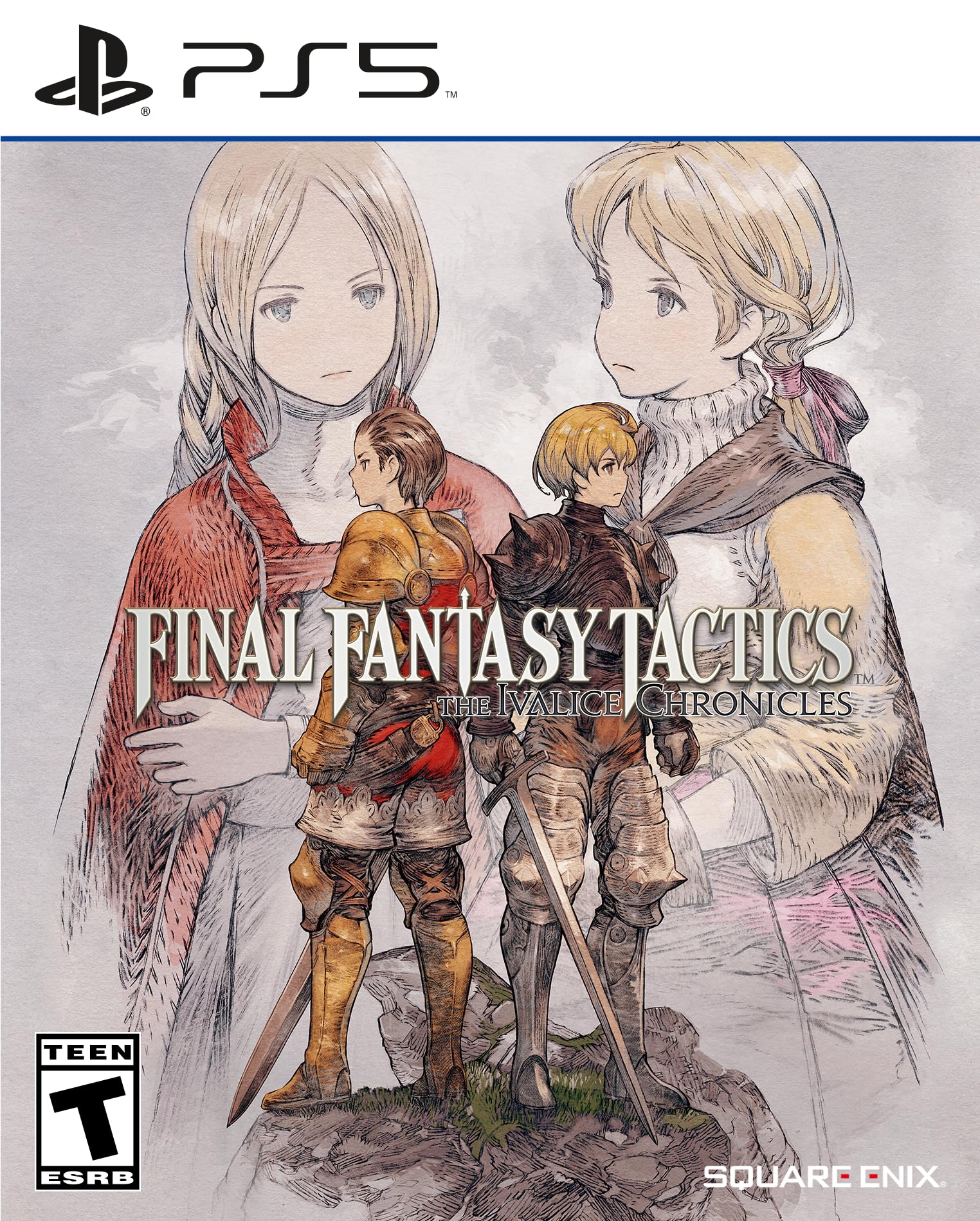
The Good: +The story is incredible, and has been expanded upon with touched up dialog and battle sequences that expand on the characters, plot, motivations, and lore +New fully voice moments really bring some of these sequences to life +The job system is incredible and full of a lot of customization with just the right amount of limitation +The world is expansive and deep, and the game provides an in game Encyclopedia to help you uncover its lore +Quality of life updates ensure a smoother experience +Players who wish to play the "original" version (though with the War of the Lions translation) still can The Bad: -The new voice sequences are great, but some of them get to be a little long in the middle of battle -Some of the new menu interfaces take time to adjust to -There is surprisingly MORE grinding here than in the original version -The additions from War of the Lions are missing --- The original Final Fantasy Tactics debuted in North America in 1998, riding on the coat tails of the original Final Fantasy VII. In its initial release on the original PlayStation, the game became something of a niche experience for players. In many cases this served as the introduction to the tactical RPG for many back in the late 90s, and it showed. The game was complex, and difficult to understand for most children of the day. Over time, though, it did find its audience and become a cult classic. Ask most Final Fantasy fans what the best spinoff is (or even the best Final Fantasy) and they'll tell you--without hesitation--that it's Final Fantasy Tactics. The game then saw a re-release in 2007 on the PSP where it was given a revamped, more flourished script, complete with a more accurate translation. After that the game has seen various ports in mobile markets, but it was clear it needed a bit of an update. Enter: The Ivalice Chronicles. A new way to experience a classic. The story of Final Fantasy Tactics follows Ramza Beoulve, a young noble who is training to be a knight. As the game begins the Kingdom of Ivalice has fallen into turmoil. The King is not in the greatest of health and will soon pass. With this happening, Duke's Larg and Goltanna see the chance to usurp power, and are read to go to war with each other. Ramza doesn't really care about the politics, but is also naive to them. His class status as a noble clouds his judgement until tragedy strikes for his friend Delita, and it becomes clear what many are willing to do for power in this world. As such Ramza embarks on a quest to learn the truth of what is actually going on. Throughout he will encounter several characters, each belonging to various factions vying for power. Final Fantasy Tactics is, at its heart, a political drama. The story is less about characters than it is the state of the realm, the actions, and struggle for power which takes place. Throughout the adventure you'll witness characters act in mysterious ways that serve their own ends, or seek to manipulate others. This makes for a story where character relationships are far more important than character development. And there is a huge cast of characters here that can be hard to keep track of. Luckily, this new version of Final Fantasy Tactics makes keeping track of everything much easier with its various encyclopedias built in. Not only will it help you keep track of the plot, but also keep tabs on all the characters and events. The story has also been given an updated translation that helps to clarify moments within the story. These changes were also done, according to Producer and Director, Yasumi Matsuno, to ensure that much of the dialog could be more easily spoken. And it shows. Much of the voice acting here is pretty good, and it's a welcome addition. There are also moments where there's more dialog, particularly in battle. These new dialog sequences help to flesh out the story and characters, but mostly they help to flesh out the motivations of the cast and make them more clear. The new dialog bolsters a lot of the story. Of course, all of this wouldn't mean as much if the game didn't play as well. Even in its time, Final Fantasy Tactics was a spiritual successor to Tactics Ogre (another Matsuno lead project), but certainly a more toned down tactical experience. In each battle the player will put forth various characters on a battle field and command them in a grid based battle system. Where you place units, where they face, and their equipment play a role. But so do other things such as the weather, height, and the terrain characters are positioned in. Even to this day there are complex mechanics that some players do not fully understand (such as Bravery and Faith) entirely. The difference is that the encyclopedias found within the game help provide a much greater understanding of these mechanics that were previously unexplained within the game itself. Final Fantasy Tactics's mechanics may not be as deep as Tactics Ogres, nor its battles as huge (and it certainly has far fewer battles than Tactics Ogre) but it's still a good game overall. Part of what makes the experience so great is the job system. Taking cues from games like Final Fantasy V, Tactics allows characters to change jobs, learn abilities (by gaining JP) and mixing and matching abilities. This allows for an unprecedented level of customization. As you progress through the game utilizing jobs, they also gain job levels which may open the door to new jobs. The amount of customization is also coupled with limitations so that a character can't really do everything. You are limited to the abilities that you can use. Every class has its own set of inherent commands, and you can assign abilities from other classes but not in abundance. This leads to a lot of ways to flesh out the units you want. The only downside to some of this is that Final Fantasy Tactics can occasionally be a grind heavy experience. Although it goes faster than the original game, it's still not uncommon to be taking a break from the story to effectively try to acquire a lot of job points as you seek to unlock other jobs and learn abilities. You can speed up battles as well, but it doesn't take away from the fact that you'll grind for a while between some of the more important events in the game. Given how dense the story and lore of Final Fantasy Tactics is, it's not uncommon for some players to have lost track of what's happening because they spent so much time grinding. Unlike other Final Fantasy titles, Tactics simply doesn't hold your hand through the story. There are no exposition moments where characters recount events that have already passed, and you have to be good about picking up on subtleties in the story. The encyclopedia will help for much of this (even allowing you to rewatch scenes), but there are some things it will not recount. Final Fantasy Tactics was considered a notoriously difficult game in its time, with gamers being frustrated at how unforgiving it could be. Particularly in certain boss fights where it felt like they could outright break the system. The game is still a challenge here, but less so than before. This is largely due to quality of life improvements more so than because they altered the difficulty too much. In particular, the game now has difficulty settings. Squire, Knight, and Tactician. With Tactician supposedly being as difficult as the original version of the game. Indeed frustrations are still abound. You'll witness the game being generous with charge time for your enemies, and you'll witness them being able to find their mark even with low accuracy. These benefits don't always seem extended to you. But even on Tactician difficulty the game is hardly a difficult experience if you have knowledge of all of the game's systems, mechanics, and recognize the abilities you need at any given time. No difficulty can stand up to someone who overtly grinds for any situation. There are other quality of life, or updated, moments here as well. It is now much easier to see the turn order, and to distinguish between friend and foe in that turn cycle. There is also an auto-save feature active in battle at all times, allowing you to reload an earlier moment in the battle if it didn't go well for you. You're also able to restart battles as well, including reformatting your party. Most important (as far as being in a battle goes) is that the interface is cleaner and easier to navigate, and more forgiving. For example, in the original game once you moved a character and placed them you couldn't reset their position to move them somewhere else if you moved them somewhere by mistake. The new grid layout also makes it significantly easier to see, and you can also adjust the angle to a more tactical view rather than being forced to continuously rotate the camera. However, there are two updates in particular I find extremely nice. The first is that the battles on the world map are no longer mandatory. In the original game (as well as its War of the Lions update) sometimes walking across the world map would draw you into a battle and there was no running from the encounter. Here, when on battle fields you can choose to enter battle or not. It is entirely up to you now. This means you can fight at your leisure, and get a move on without being interrupted. The second update that is really nice is that when it comes to certain marathon battles where you must fight multiple battles in a row, you are no longer locked into these sequences should you save (many a player are having flashbacks to Wiegraf already). You can "flee." You'll have to restart the sequence of battles again, but you can no longer soft lock yourself into being unable to finish the game based on being caught in a battle sequence for which you can no longer return should you be unprepared. Of course, if you hate all of these new updates, the "classic" version of the game is still there, and they've done nothing with it except put the script for War of the Lions in there. This version is presented in its native 4:3, has no smoothed out graphics at all, and utilizes the same interface. You can certainly see how dated the experience has become over time. This doesn't necessarily make it bad; it's nice to have the option if you so desire it. But it also makes you glad for some of the improvements they have made. In particular, it's nice that the updated version has a fast forward and doesn't have random encounters. This also means the "classic" version is harder given that you can't really undo mistakes either. Some players may prefer this, but for many others it'll make you glad some of the updates in the remastered variation exist. That being said, I do miss the original death screams from the original version. In the updated they've been replaced with characters often having voiced sequences for when they get knocked out. Of course, some players may not like that the "original" game utilizes the War of the Lions translation either. Despite the fact that the original PlayStation game had a very messy translation that often rendered the story either needlessly confusing, or even translated things poorly enough that you didn't even get the entire experience, it is still preferred by diehards. The War of the Lions translation admittedly has some purple prose, but it is also giving the world a flourish it did not previously have, and also provides some clarity to the story, without it being too difficult to understand. It may not be as "to-the-point" of the original 1998 translation, but it also sounds significantly less robotic and devoid of characterization, and it doesn't actively confuse or leave out bits of the story. Nevertheless, this may lead many to opine the "original" version is not original at all, despite utilizing the same interface and mechanics, while omitting the quality of life improvements. I sympathize, however, I never found the War of the Lions translation too taxing on the brain, nor tinny to the ear. I do however, find it more imaginative than the 1998 translation. The new version isn't flawless, of course. I enjoy the new dialog sequences in battle, but some of these sequences are too lengthy. These new sequences in battle flesh out the characters, plot, and motivations more, but it also makes the battle come to abrupt stops. And in some battles there are multiple sequences where this will happen. Additionally, while the new interface in battle is great, it's not always as straightforward in the menus itself where you have to sift through more menus than you used to before (especially when learning new job abilities). This is more of a nitpick and the fact that I have muscle memory of the original, but there are moments when you'll spend more time in the menu here because there's more to go in order to reach what you need. It's not a difficult adjustment to make by any means, it just means that navigating somemenus takes longer than it should. They've also rebalanced some jobs. Some of these rebalances are great, but others are a bit annoying. For instance some abilities require more grinding to learn than previously, and unlocking some jobs also takes longer than previously. They've eased off on many things in the game, but it's surprising that in doing so they made the game far more grind heavy than either its original version or War of the Lions. Speaking of War of the Lions, it's also disappointing that the extras from War of the Lions are absent. In particular, it's unfortunate that hidden characters Balthier and Luso are nowhere to be found, and some of the extra battles placed into War of the Lions to flesh out the story are also gone. In particular, Delita and Ovelia get LESS development here than they did in the War of the Lions version as a result. The animated sequences from War of the Lions are still here, however, but they can only be accessed by going into the encyclopedia, which is something you might not realize unless you're actively looking for them. This also means the new jobs from War of the Lions are gone, but the omission of those jobs isn't quite as bothersome given that it took a needlessly long time acquire said jobs and utilize to the best of their ability anyway. The War of the Lions extras are missing, however, as a deliberate choice since Matsuno had less to do with that version of the game, and since Square believed more players would be familiar with the original PlayStation version of the game. I don't find the loss of the War of the Lions content too terrible. The game is overall still fun to play, with everything being rather familiar. The game has updated visuals in the sense that everything is smoothed out and looks pretty good. Final Fantasy Tactics was never a graphical powerhouse, but it had good sprite design and artistry. Each battle field looks like a miniature diorama, and that's still true here. It's still a charming look, and I never tire of seeing familiar sprites of Final Fantasy monsters. Over the years the game has aged gracefully in comparison to more polygon based games of the day (such as the original Final Fantasy VII). The soundtrack is also still a marvelous soundtrack. There are no remastered recordings, however. Unlike other Square-Enix remasters such as the Final Fantasy Pixel Remasters or Tactics Ogre, you aren't being given an updated soundtrack. It's largely the same. The real question is whether or not the experience is worth it for those who revisted the land of Ivalice again and again in the past. I'd say it's worth a look. In particular, if you liked the story they've taken a lot of care to make sure you have the chance to really explore it due to how fleshed out the Encyclopedia is. Final Fantasy Tactics: The Ivalice Chronicles takes some surprising cues from Final Fantasy XVI. Not only can you now re-view event sequences past, but it's much easier to dive into the lore of things which you might've missed. You can view state of the realm moments to help you get a better look at the story, and it does more to help you keep up with character development. All these things are optional, so if you don't want this expansive experience you don't have to take it, but the fact that the game goes through such lengths to supplement and provide more lore is,I think, worth checking out some of the new stuff alone. Additionally the new voice sequences in battle--long as they may sometimes get--truly do add another layer of storytelling. The game seizes upon its themes of class and subjugation more, making for what feels like a very timely experience to revisit the game. You aren't just getting an updated experience, there are aspects of it that will surely feel new. It's a shame to miss out on the extras from War of the Lions, but I feel there was actual care and devotion put into the game by people who legitimately loved it and understood what they had. It's flaws are there, but they are redeemed by such care and devotion. If it has been a while since you took the time to visit Ramza and his journey, this is a good time to jump back in and remind yourself why Final Fantasy Tactics is so revered. I imagine that some people may yearn for the original experience found on the original PlayStation, but I think once you settle in, you may like this new experience and be glad you took the time to at least engage with its amazing storytelling and lore. Read more