
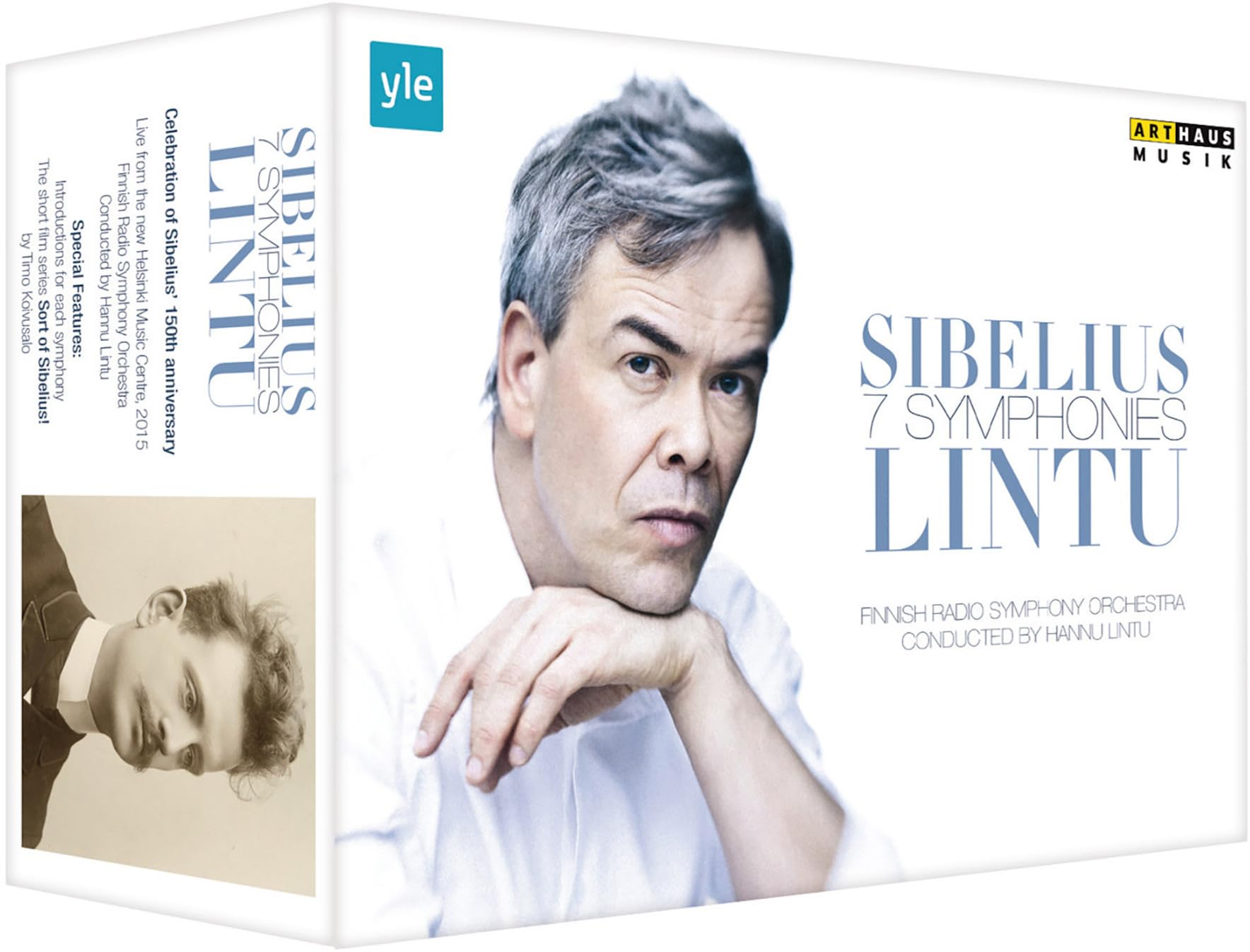
Good performances, valuable introductory material
When I wrote in 2015 (Fanfare 39:1), in a review of Hannu Lintu’s recording of Sibelius’s Lemminkäinen Suite, that Lintu hadn’t recorded much music of his countryman Sibelius, I was unaware of this set. This video Sibelius symphony cycle was issued in that year to commemorate the 150th anniversary of Sibelius’s birth; it has just come to my attention in 2022. An important note: Amazon indicates in its listing that the Blu-rays are Playback Region B/2 and therefore unplayable on North American equipment, but in fact they are region-free and played fine on my Cambridge Audio player. I am reviewing this set in the same issue as the Berglund-Chamber Orchestra of Europe video, and the contrasts between the two are considerable. Lintu is a much more demonstrative conductor than Berglund, and his interpretations tend to be more expansive and volatile. The First Symphony is a case in point. After a very slow clarinet solo—which Lintu doesn’t conduct—the Allegro energico is exciting, with much rubato. The volatile tempo treatment continues in the second movement, and the Finale is dynamic. The opening movement of the Second Symphony is fairly standard, but in the second movement Lintu whips up the fast sections, emphasizing the music’s contrasts. The transition from the scherzo to the Finale begins slowly, but builds up steam; the Finale itself is dramatic. There are no great surprises in the Third Symphony; the tempos are standard with the exception of the opening section of the third movement, which is faster than usual. Details, such as the all-important B-C alternation in the timpani in the first movement, are good. The opening movement of the Fourth Symphony is on the slow side, but is well-sustained. Likewise, the third movement lasts almost 12 minutes, but builds nicely to its climax. The fourth movement is lively. Lintu uses glockenspiel. The first movement of the Fifth Symphony is expansive, but the second part is immediately faster, which I think is a miscalculation. There is an attacca from the second to the third movement; Lintu broadens the tempo for the “swan” theme. In the Sixth Symphony Lintu views the second movement as a slow movement, and conducts it accordingly; there is again an attacca from the third to the fourth movement of this symphony. The Seventh Symphony features flexibility of tempo within an overall relaxed pace; even within sections the tempo is not monolithic. Video values are good, although I would have liked more orchestral close-ups, particularly of the winds. The sound is excellent. The playing is high-caliber throughout, and there is little in Lintu’s interpretations that will be considered controversial. This is a fine Sibelius cycle. But the set is likely to be found attractive for the extras, which are extensive. First, there are roughly 10-minute introductions to each of the symphonies, providing informative background on the pieces. These introductions also feature video of Lintu on location in Helsinki, Vienna, Berlin, and elsewhere. There is much interesting information here, including the fact that Sibelius hoped to study in Vienna with Bruckner (they ended up never meeting). The second “extra” is titled “The Themes of the Symphonies,” and features interviews with Lintu as well as illustrations played by the orchestra at separate sessions. (There are several personnel changes between the performances and the sessions.) Here Lintu shows himself to be highly knowledgeable about the scores; he discusses several programmatic considerations, for example, pointing out that the F Major passage in the second movement of the Second Symphony is labeled “Christus” in Sibelius’s sketch, and exploring the Third Symphony’s relation to an incomplete oratorio. Lintu is quite perceptive about the structure of the Fourth Symphony’s slow movement, and he recognizes that the final chords of the Fifth are verticalizations of the “swan” theme. He is also most cogent concerning the issues of tempo in the Seventh. One of the more interesting features is that in the sessions he has the orchestra play rejected versions of that symphony’s ending, and of the Third Symphony’s transitional passage. The third “extra” is a series of short films by Piia Hirvensalo called “Sort of Sibelius!” These are whimsical vignettes focused more on Sibelius’s life and personality than his music, and feature actors portraying Sibelius and his wife, Aino, as well as animations. Also featured are interviews with such “authorities” as a handwriting expert, a costume researcher, and a wine connoisseur. There are also extensive interview excerpts with composer Kaija Saariaho, called here “The Sibelius of Our Times,” which are much more about her than about Sibelius. I doubt that I will be returning to these films. This set, housed in a 6x8x3-inch box, is valuable not only for the fine performances but for the informative introductory material. I continue to be impressed by Lintu, both for his conducting and for his verbal observations about the music. Recommended. Read more


