
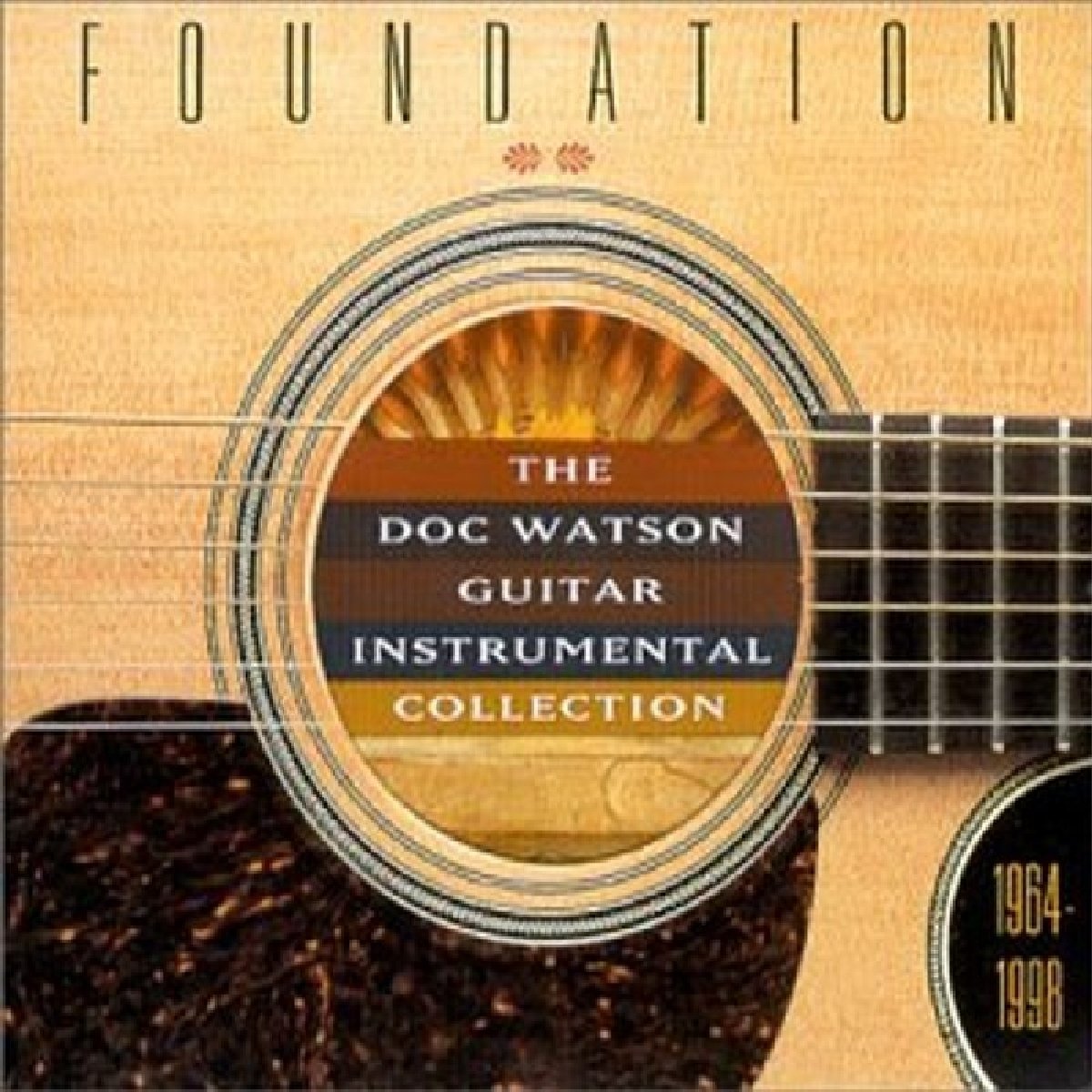
Happy little album which showcases the art of the guitar as a lead instrument and as a rhythm instrument.
This album immediately drew me when I first heard it on YouTube. In it Arthel "Doc" Watson plays mostly upbeat fiddle tunes, some dating to the 1700s or before, as well as a few "newer" country tunes. As such most of the songs are a very good complement to his older collection of "The Vanguard Years" which I also highly recommend. A lot of these tunes are damnably hard to play full speed or even 3/4 speed on the fiddle and I have no idea how he manages to speed them up further, play them on the guitar and have them hold together. People always praise the top rock and blues pickers such as McCartney, Clapton, Santana. I'm sorry, they (and great country pickers like Roy Clark, Chet Atkins and Les Paul too for that matter) will never top Watson. Once you become familiar with his music you will hear echoes of his licks copied by nearly everybody (including the six above mentioned), no matter what you call their style. In the rock world one can better see his influence in such musicians as Garcia and arguably Springsteen, but he's everywhere. Watson was a mostly self taught musician who was one of the leading 20th century instrumentalists of any style and using any instrument. His main instrument was guitar, though I've heard a number of his banjo, mandolin and vocal tunes through the years. Although he was an enthusiastic singer with a lot of appeal he was probably not the best vocalist in his home county, probably not in his home church either. (But he made up for it with his guitar.) For those who are really taken by his singing and want to hear a simpler style of his instrumentals I'd recommend his 1987 album, "Portrait". You can get a hint of his musical complexity in the book "Doc &Dawg", which is a transcription in tabs and notation of his CD of the same name. (That particular CD also has some tunes which illustrate my point that players like Clapton and Santana show his influence, though one could argue the influence was in both directions.) Read more