Gossip, surveillance AND paranoia? Clouzot delivers! Criterion bluray.
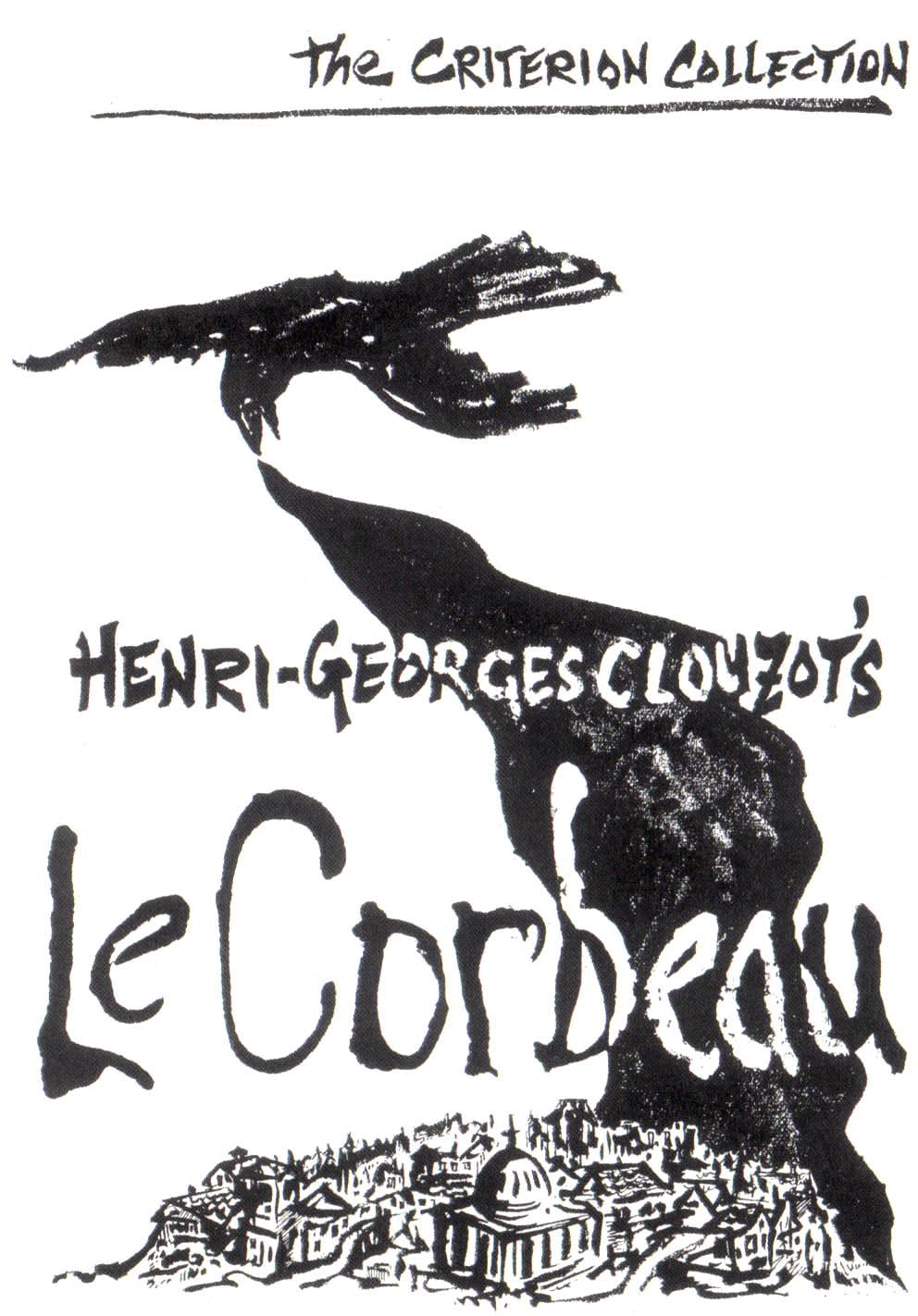
Criterion bluray. From Henri-Georges Clouzot: The genius behind Diabolique, Wages of Fear and the mod Prisonnière often titled The Chained Woman for obvious reasons). Le Corbeau caused an uproar when it was released in France in 1943. Obsessed with how a society can be poisoned by paranoia and surveillance, the film was perceived, correctly, by the Vichy government to be a parable of France’s occupation by Germany during World War II, and the climate of mistrust and informing that was fostered. The right-wing government saw Le Corbeau as immoral, while the left-wing thought it besmirched France’s steadfastness during terrifying times. The film was a hit, but Clouzot was blacklisted anyway. Le Corbeau is still powerful decades later, and critics still chastize it for its misanthropy. Clouzot struck a social nerve that we’d prefer to remain subterranean. Admittedly, Le Corbeau is easy to dislike, as its cynicism is relentless. There’s not a moment of joy in this short but overwhelmingly dense film, or at least not one that isn’t shrouded in the threat of persecution. In a small village in provincial France, a person sets about writing and distributing “poison pen” letters that air the citizens’ dirty laundry. The letters are signed by Le Corbeau, or The Raven, and by the time the letters begin to circulate, the script (by Clouzot and Louis Chavance) has already sketched the village’s prominent citizens in a series of pitiless strokes. Clouzot has devised Le Corbeau like a steel trap, suggesting a series of minute, interlocking gestures that can ripple into actions of profound consequence at any moment. No small thing is without importance, and so we’re not allowed to take anything for granted. The protagonist is Rémy Germain (Pierre Fresnay), a doctor who performs covert abortions, goading Le Corbeau’s wrath; every one of the mystery person’s actions seem to center on Germaine in some way. Germaine has a “will they or won’t they” thing going with Laura (Micheline Francey), the much younger wife of Michel Vorzet (Pierre Larquey), a psychiatrist who’s been around the block and who offers a wry running commentary on human nature. One gathers that Vorzet could be Clouzot’s surrogate. And if we take Vorzet on those terms, the film’s resolution packs a particularly sick, auto-critical punch. A child might be stealing money, and might have a sexual fixation on Germaine, as does Denise (Ginette Leclerc), a sexy young woman who seems to sit around in her flat in lingerie all day, waiting for Germaine to “inspect” her. We meet drug addicts and old maids, embezzlers and cuckholds. Le Corbeau has many targets to choose from. Everyone, no matter how “good” or “bad” they are, to use facile labels, has something they’d prefer to keep in the dark. As the letters pit the characters at one another’s throats, sparking disaster, modern audiences may recognize Le Corbeau’s vast range of influence. For one the legendary The Twilight Zone episode “The Monsters Are Due on Maple Street” tells a similar story with sci-fi trappings and a fixation on the paranoid puritanism of the House Un-American Activities Committee. In fact, “the town with many secrets” has become a trope, in horror films and novels and dramas and soap operas alike, while Le Corbeau’s taunts bring to mind the riddles issued by killers in too many genre films to mention, especially those of the Italian gialli of the 70s. The setup is popular because it can accommodate any sociological current with little modification. Contemporarily, Le Corbeau could be a parable of political divisions as well as of the anonymous blood sport of outing people for misdeeds online. For such reasons, the film might be more approachable than most older movies for younger audiences. It communicates a series of fears that they know, quite viscerally. Le Corbeau’s brutality (recall the bit with the cleaning woman in Wages of Fear) is easy to discern, then, and Clouzot’s unusual frankness about sex and drugs further suggests a clearing of the hypocritical, euphemistic air; a moment here, of a woman biting a potential lover’s hand, is kinkier than most modern directors’ more elaborate sex scenes. Clouzot continues to whip up a frenzy of emotions, often filming the characters in intimate close-ups that are engulfed in a storm of shadows. Certain images—of a broken mirror, of a woman standing on a hill at a slant in a shroud—connote deep fissures in reality, evoking the madness of what a total reckoning with ourselves might involve. Clouzot’s obsession with guilt almost inevitably invites religious connotations, and his intense tableau sometimes recalls the more neurotic compositions of Carl Theodor Dreyer’s films. Less easy to discern in Le Corbeau is its preoccupation with forgiveness. Clouzot doesn’t believe that everyone should be exposed for the heathens that they are—quite the opposite, in fact. It’s understood here that everyone has their sins, and that a few secrets, a little bull't in other words, is necessary to grease the wheels of social order. Germaine is persecuted so fervently in part because he holds himself at arm’s length from the other citizens of the village, believing himself superior. He has a past that’s hardened him, and the potential savagery of such hardening is embodied by Le Corbeau’s letters. People, all people, often need to be cut some slack, which neither Germaine nor Le Corbeau seems to understand, or perhaps they understand it all too well. Sins spring from pain, and the poison pen letters, a virus that proves communicable, originates with a collapsing marriage. Le Corbeau’s moral scheme could be encapsulated by that often-misquoted passage from John 8:7: “He that is without sin among you, let him first cast a stone at her.” Though Clouzot invests such humanistic notions with a hard, twisted irony. In the end, Le Corbeau is revealed to be one of the town’s most empathetic people, as the gift of understanding can be quite easily utilized for perverse and destructive means, especially, once again, when warped by pain. For the gift of empathy is in part the gift of divining weakness. The disc: This release is sourced from a 4K restoration that was completed at Eclair Laboratories in Epinay-sur-Seine, France. While improvement over the 2003 Criterion DVD was inevitable, given the passage of time and evolution of home-video presentation, the transfer still looks and sounds outstanding. Depth and clarity are particularly improved here, as are the subtleties of the shades of black and white, especially evident in shadows and skin tones. Landscapes are often sharp, while crowd scenes are somewhat softer, though every image is appealingly organic. The French monaural soundtrack is crisp and sturdy, with the exception of some slight distortion in, once again, the crowd scenes, which is probably inherent to the source materials. Extras: The liner notes for this package include an essay by Alan Williams, a professor of French and cinema studies, that serves as a short but valuable primer on the social context of Le Corbeau’s production. The film was made while France was under German occupation, and Henri-Georges Clouzot collaborated with Continental Films, a German film studio whose goal was to produce fodder to pacify the masses. Clouzot instead made a film about the nature of collaboration and intimidation, as well as his own role as a PR agent for the enemy, and his career temporarily suffered for it. Two other supplements tell the same story with less detail: an interview with filmmaker Bertrand Tavernier, and an excerpt from a 1975 French documentary titled The Story of French Cinema by Those Who Made It: Grand Illusions 1939–1942 that features an interview with Clouzot, who’s frank about collaborating with the Germans. Everything here is ported over from the 2003 Criterion DVD that is now out of print, with the theatrical trailer rounding out the package. New bonus features for this edition would have been most welcome. Read more