Numbers Guy—September 29, 2020✓ Verified purchase
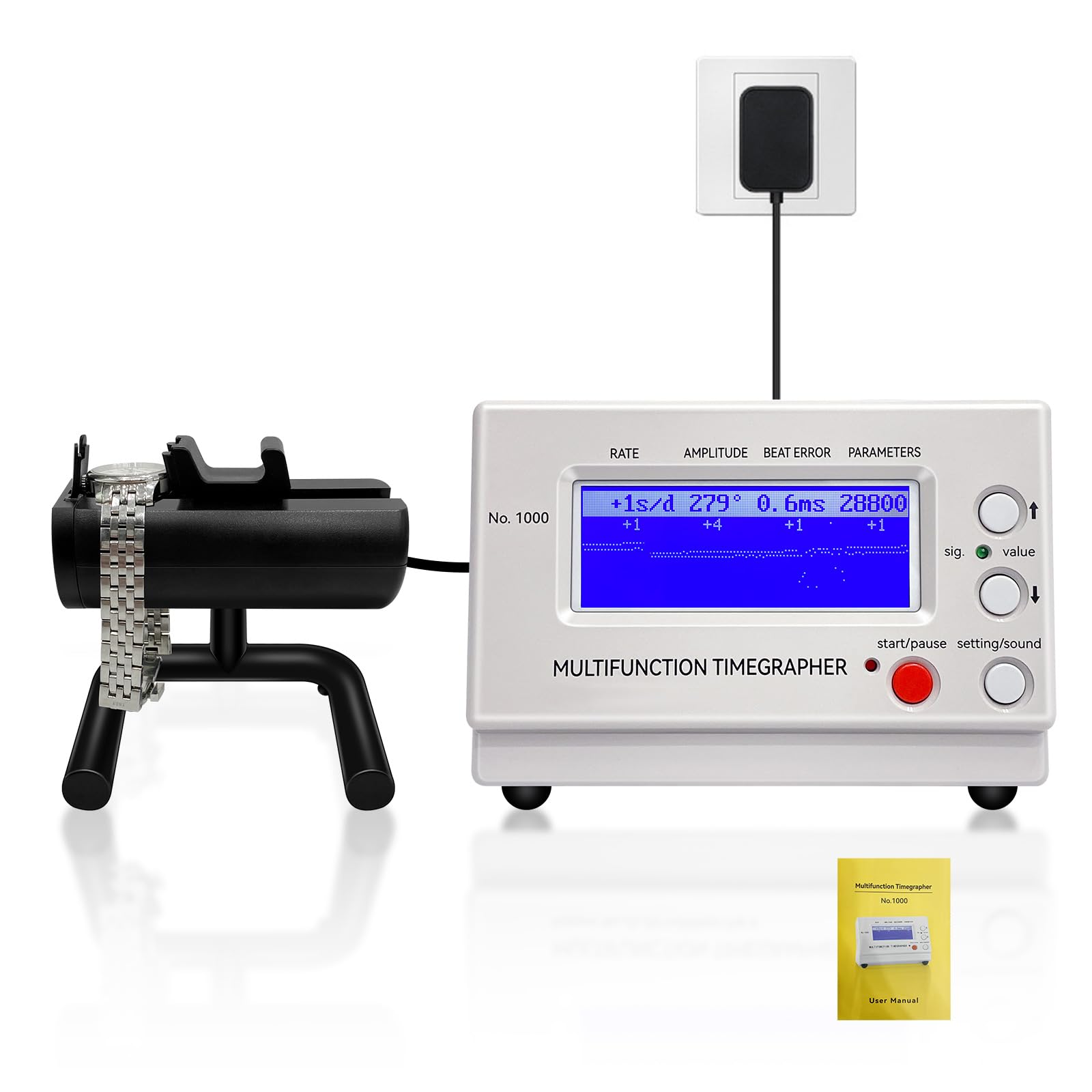
Works perfectly and is very easy to set up and use. Product is very well made, functions smoothly and effortlessly and looks to be of very high quality. I'm a beginner hobbyist in the field of horology and kept reading about the use of a timegrapher. Weishi seems to be the go-to brand used by most of the hobbyists and experts I follow. This was a very useful and enjoyable purchase. It provides instant results that disclose the overall health on the operation of your mechanical watch. I now have a way of determining if a new watch I've purchased is operating correctly without having to use it for an extended period of time. It's readings have proven to be very accurate. Very happy with purchase Read more
jackbnimble—January 8, 2026✓ Verified purchase
Very, very good at this price point and works very well. Saved me some serious money when buying expensive watches that weren't tuned properly. If your an enthusiast or a collector this is a must have tool for automatic watches. Read more
Bob Wilson—March 12, 2024✓ Verified purchase
I'm very new to watchmaking, and at first didn't know if I'd like it or not. Turns out I do! I started out, I imagine, the way most hobbyists do by buying an inexpensive set of watchmakers screwdrivers, a workbench mat and collected a small but decent magnifying glass and a selection of small storage containers to hold parts. Well, every few days I found I was perusing watchmaker tools online because I was stopped for need of things (tweezers, oils, you name it). But two things really became important to have: First, better ways to see the minuscule parts, and second some way to regulate the watches I work on more precisely and with better results. After all, if you can't see something you can't service it, and if you can't tell how accurate and well-running a piece is after you've finished, how do you know if what you did improved it? After realizing these two needs I first ordered a decent, but very affordable binocular microscope. This has made for a tremendous improvement in what I can see and do. I also ordered an inexpensive set of jewelers loupes, which allows me to do those things that there's really not room enough to use some tools on when using the microscope. As for some way to test watches for accuracy and health, well it seemed that a Timegrapher was the accepted way that most people in this endeavor are using currently. I'd watched many videos of the the device in use by almost all of the online amateurs and even some of the pros were testing the health of the watches they worked on. The longer I persevered finishing work on a watch and then checking it for accuracy and consistency of the following days, the more I found I seemed to be chasing my own tail! Yeah, I had a few good results, but honestly it was taking a lot of the fun out of my projects having to take days to see if I was even close in my diagnosis and application of effort. I finally bit the bullet, admitted I was hooked and ordered a Timegrapher. I told myself if I don't continue watchmaking the microscope is still a useful tool to have, as I am a retired hobbyist and work on electronics, computers, jewelry, etc., so the microscope was a good buy anyway. But if I stop working on watches, what will I do with a Timegrapher? Well, since it arrived (and I put it to use immediately!) I don't think I'm going to stop working on watches anytime soon. It's really brought the fun back into it for me. It's really fulfilling to "see" and know the results of what your work does. But there's more to this than that, as this device is really useful to use before you ever open the case on a watch. It can show you before you start work how far off the piece is in keeping time and doing it consistently. When you take the time to try to decipher what the screen is telling you, you can see what the health of the watch is. I regulated three of my auto-wind watches in a row using the Timegrapher, and got them running really well with keeping the best time since I bought them. On my fourth watch, my nicest Seiko dive watch, it indicated that it wasn't running well and was off quite a bit in its accuracy. I opened it, placed the movement on the Timegrapher and went to work. At first it was going well, with my pulling the Seiko back close to how it should have been running. But it simply wouldn't budge past a certain point, and that point was not really acceptable. I thought that this watch (I bought it online, used) is a model that is currently still for sale new, so it shouldn't need a service yet, so what's going on? The longer I worked with it on the Timegrapher, the readouts were going the wrong way! Then, abruptly, the screen became a little snowstorm of white dots and the rate and beat error went off-scale. What had happened? I hadn't done anything other than move the regulator very small amounts, so I put on one of my loupes and looked long and hard at the balance. Well, the hair spring appeared to have the first coil, down near the balance shaft "looped" or "uncoiled", as if the balance wheel had turned a full 360 degrees and was being "unwound!" I was amazed, as I couldn't understand how this could have happened and yet the watch had been running everyday since I bought it. At this point I was done with the Timegrapher, and took the watch off and laid it out to look closer. What I found was the balance shaft was able to do that "360" because the bottom pivot point had broken off. This allowed the shaft to turn past the pallet fork because the shaft could actually move back and forth when the watch was shifted just right. Apparently, if left in one position, that balance continued to work well enough to allow the watch to run, just not well or consistently, which is what I'd been experiencing. But until I saw it on the Timegrapher there was no easy way to see the effects of the damage. As for the balance doing a "360" this stopped the hairspring from working, stopping the watch dead. I've already ordered two replacement balance completes (I'm new at this and having a spare just in case is probably a good idea, just in case I make a mistake). So, did the Timegrapher tell me exactly what went wrong? Did it warn me of imminent failure? Did it offer a fix for the problem? Well, I have to say no to all three questions. Does it mean I wasted my money? Absolutely not! It was amazing to watch my poor Seiko take its dive! I'd seen that type of "snowstorm" readout in some of those videos online, but seeing it take place on my watch, as the failure happened and being able to tie that readout to the actual failure was simply impressive and I will not forget the experience. Was this a good thing? It wasn't good to have my nice watch fail, but it was a great thing to see the capability of what this device does. It was a good learning experience, and it brought home exactly what the screen is telling you. Sure, the cost isn't dirt cheap, but neither are nice mechanical watches. Besides, for less than the price of one of these watches you get a well-made device that can tell you a lot about your watches. I definitely recommend the Timegrapher No. 1000. Read more
Zodoz—November 13, 2017✓ Verified purchase
I bought this to help me regulate and adjust the beat of the SKX007. The local jewel charges over $100 to do the same, and if I can learn to do it, it would pay back the cost of the Timegrapher many fold. I've worn mechanical watches since the 1940s, and a good mechanical watch can run trouble free for decades except for speed adjustment, as they age or if they are hit hard by a fall, accuracy is first to suffer, and easiest to fix and is the the most common thing I use to go a watchmaker for. After 1 hr of work I got the SKX007 to +3 sec/day, better than the factory -10sec/day, this is accuracy measured over 1 week and taking all data sheet mentioned positions into account. Pros Easy to use Comes complete ready to run Low cost Quality microphone stand Cons The PSU broke within 1 hr of use The Timegrapher is housed in a mod to low quality housing, but does the job Instructions supplied help, but are inadequate, but there is a lot of info on how to use one on the web I repurposed a discarded PSU to work with this device rather than return the whole thing just for the PSU. Also, the tic-tock is not real, but it affects the accuracy of the microphone as it picks up the noise. You can get best results running the Timegrapher sound OFF. Minus one star for the loss of the PSU. Read more
No.99—February 23, 2026✓ Verified purchase
I bought this back in 2016 and it is still working reliably without any problems. Read more
Daniel H.—January 7, 2026✓ Verified purchase
Very useful tool for anyone into watches. It gives clear, consistent readings for rate, amplitude, and beat error, and it’s easy to set up and use. Helped me accurately regulate and compare my mechanical watches at home. Solid performance for the price and a great addition to any watch enthusiast’s toolkit. Read more
Sergio Geuna—December 26, 2025✓ Verified purchase
El producto está bien, no tuve problema, pero pague un extra para que me llegara el 12 de diciembre y me llegó el 15 de diciembre, perdí 37 dolares Read more
The Toxster—January 10, 2026✓ Verified purchase
Great tool for measuring the accuracy of your watch. Helps determine when your watch needs servicing/adjustment. Or just for fun! Read more