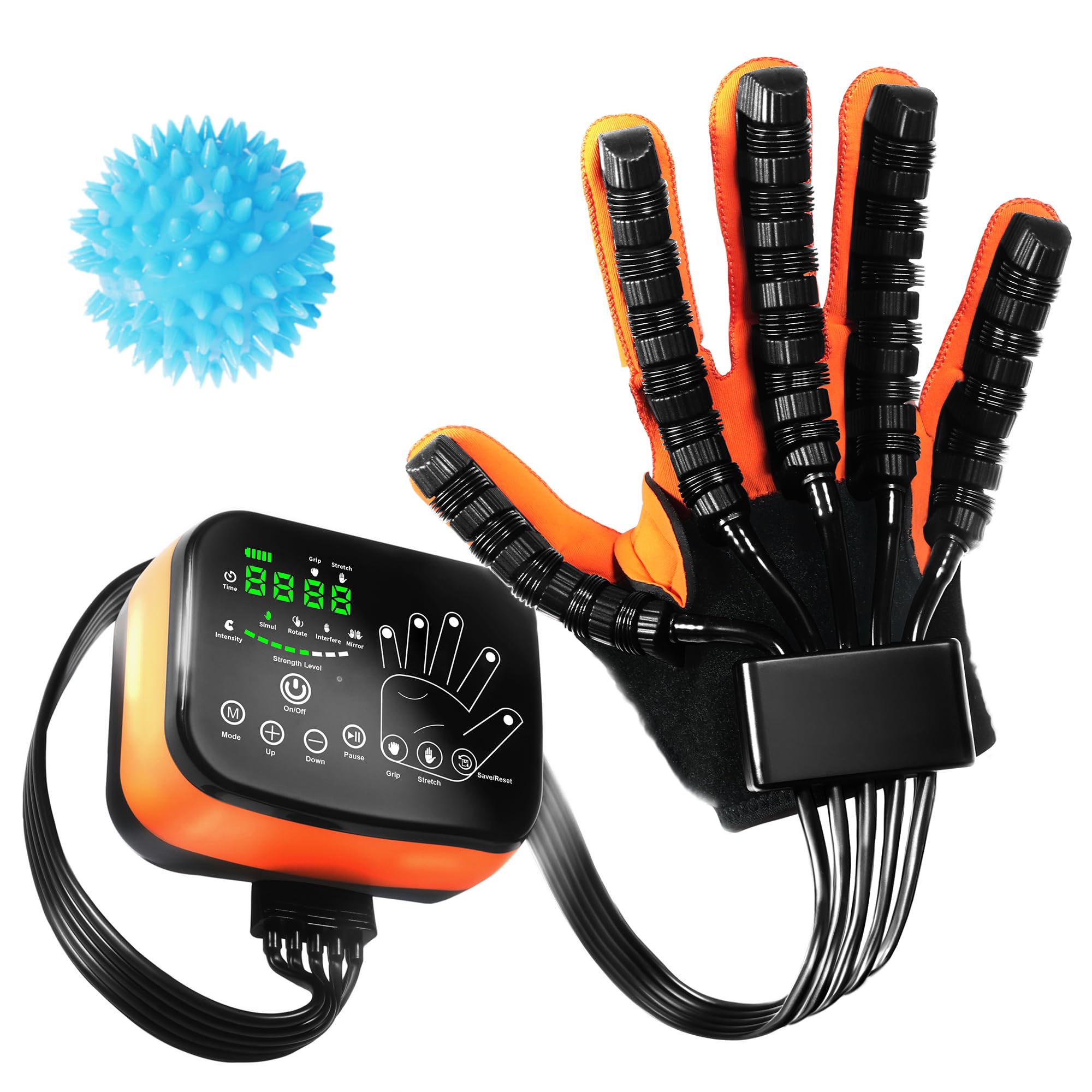
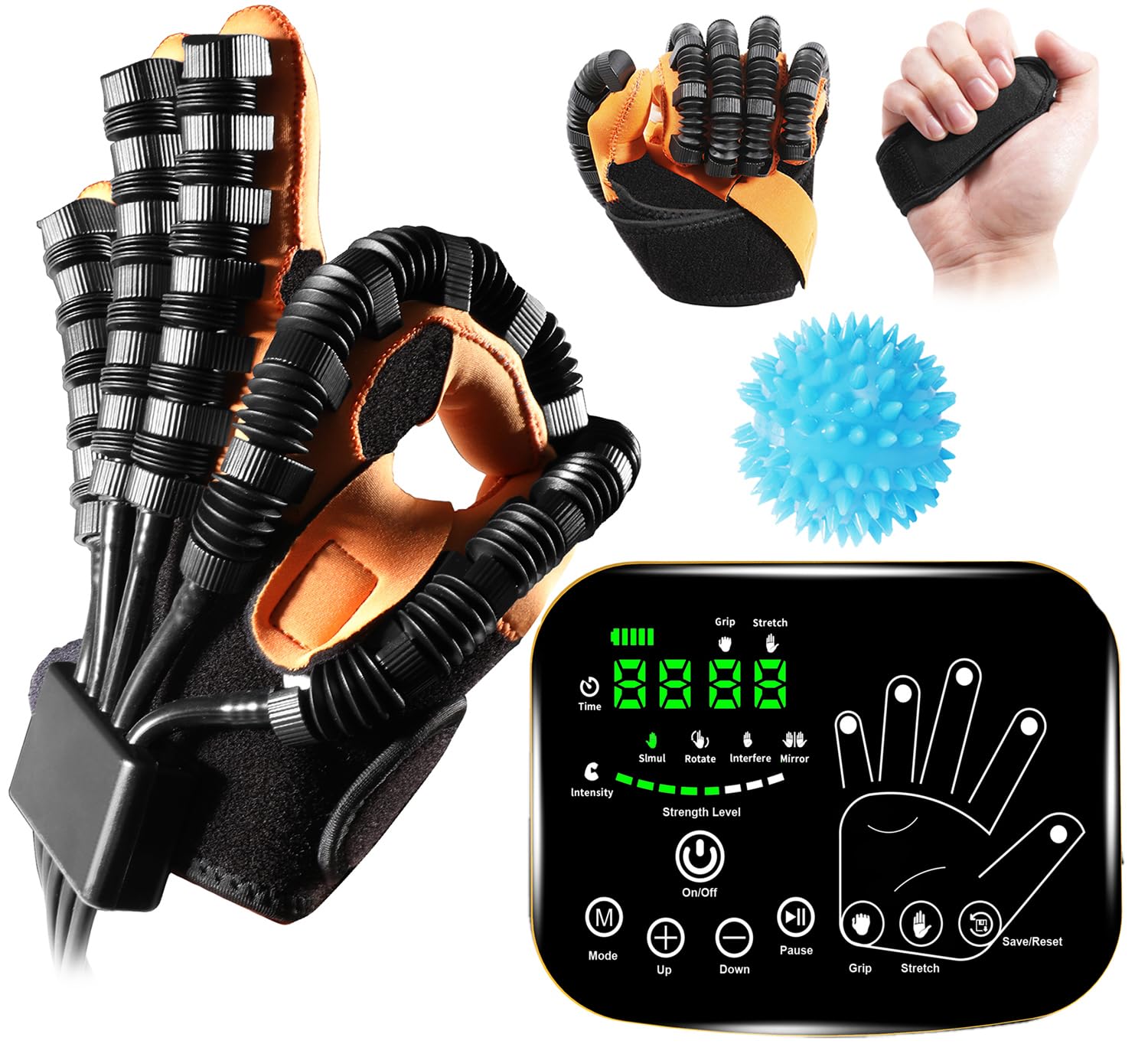
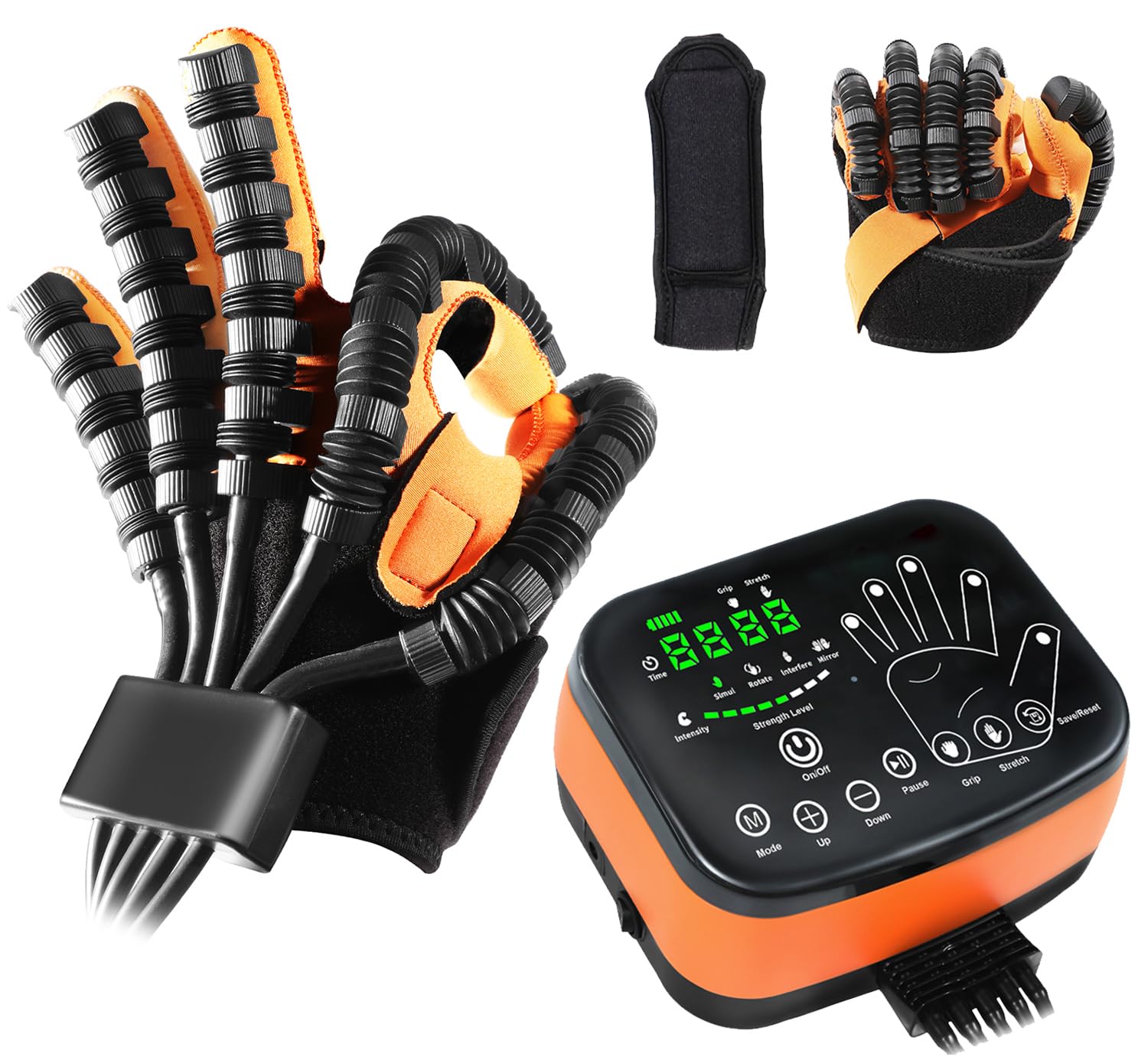
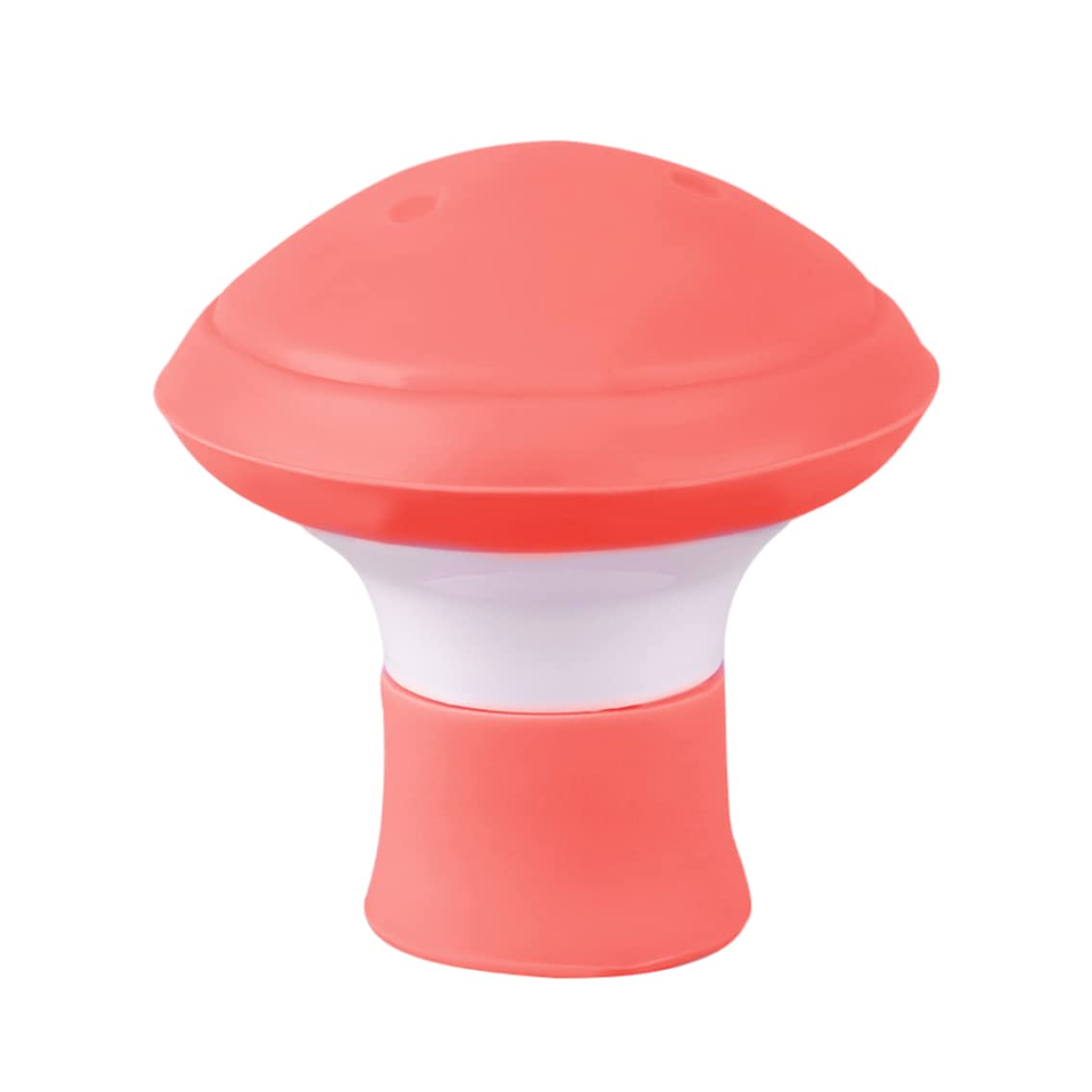
The media could not be loaded. The YIOCHOS Rehabilitation Robot Glove comes with a 19" Type C USB charge cord for a Mirror Mode hand strap pushbutton, a soft spiked training ball for improving hand strength, and a 13.5V @ 2.0A (27.0W) wall charger with a 38" long cable for a rechargeable main control unit. A small red light near the center of the control panel shows red while charging. It turns off when the control unit is fully charged. The glove can be used either with the controller plugged in or using the internal battery. The charging cord is a little short, so I find it easier to fully charge the main control unit first and then operate the glove using only the battery. The air pump inside the control unit is loud, so it should be used where it won't disturb others. The glove has 3 hook and loop straps to hold it in place on my hand, one goes around my wrist and the other two between my fingers. The straps don't have to be very tight. The fingers and thumb slide into stretchy foam sleeves that have the pneumatic actuators on the back. These sleeves are tight and can be a little tricky to put on. I find it easiest to fit my fingers first and then my thumb, before attaching the 3 straps. The glove is not uncomfortable, but I find even the large size restricts to blood flow in my fingers enough for them to feel cold after a few minutes. If you are between two sizes on the size chart, go with the larger one. The hose ribbon is 39" long and consists of 5 pneumatic tubes connected together. A single plug on the end inserts into the main unit. The plug is slightly curved, so it cannot be inserted incorrectly. Since it needs to be airtight, it does takes some effort to insert and remove the plug. The Reference Guide is very well done with a lot of symbols and numerical references to the diagrams for easy understanding. The font is also large making the text easy to read. It really is only a reference though, since the main control unit is very intuitive and simple to operate. The movement intensity can be adjusted using the Up and Down buttons. The Grip and Stretch duration times can be adjusted independently using dedicated buttons and then saved for future use. Also, individual fingers can be turned off or on as needed. There are 4 exercise Modes that can be selected: Simul Mode operates all selected fingers together, Rotate Mode cycles through the selected fingers one at a time, Interfere Mode switches between the thumb and the selected fingers together, and Mirror Mode uses the hand strap pushbutton to follow the opposing hand. This robotic glove works very well and has a lot of options to customize each rehabilitation session. Other than the noise of the main control unit, the only thing I find slightly annoying is that even though the finger sleeve liners are soft foam, I can feel the stitching rubbing against the sides of my fingers during operation. Read more
As a 40-year-old woman who has helped care for both a parent and an in-law during recovery, I know how emotional and challenging hand rehabilitation can be. When someone you love struggles to button a shirt, hold a spoon, or squeeze your hand the way they used to, it really hits home. That’s why discovering the Rehabilitation Robot Gloves for Dementia, Stroke, and Hemiplegia Patients, Hand and Finger Function Rehab, Hand Therapy Devices for Stroke, Hand Trainer for Stroke Rehab has been such a meaningful experience for our family. First and foremost, this device offers something incredibly important: hope. Hand and finger mobility can be one of the hardest things to regain after a stroke or with certain neurological conditions. Traditional therapy is wonderful, but it isn’t always enough on its own. These rehabilitation robot gloves add an extra layer of support by helping guide the hand through natural opening and closing movements. Watching the glove gently assist my loved one’s fingers in stretching and gripping again was honestly emotional. The design feels thoughtful and patient-focused. The glove is soft and comfortable, not stiff or intimidating. It wraps securely around the hand without feeling tight or restrictive. For someone already dealing with weakness or limited movement, comfort matters so much. The materials feel lightweight and breathable, which makes longer sessions manageable. One of the things I appreciate most is how easy it is to use. The controls are straightforward and not overly complicated. As someone who isn’t especially tech-savvy, I was relieved that I didn’t need a complicated manual or advanced knowledge to get started. You can adjust the intensity and choose different training modes depending on the patient’s needs and progress. That flexibility makes it feel personalized rather than one-size-fits-all. The way the glove gently assists finger extension and flexion is impressive. For stroke and hemiplegia patients, even simple movements can feel impossible. The glove helps guide those movements in a controlled, repetitive way, which is exactly what rehabilitation requires. Repetition builds muscle memory, and this device makes that repetition achievable at home. I also love that it encourages independence. Therapy appointments are essential, but they’re often limited to a few times per week. With this hand trainer, my loved one can continue practicing daily from the comfort of home. That consistency makes a huge difference. It turns downtime into productive therapy time. Instead of waiting for the next appointment, we can keep the recovery process moving forward. Emotionally, this device has helped restore confidence. When someone loses hand function, they often feel frustrated or embarrassed. Simple tasks become reminders of what they can’t do. Using the rehabilitation glove gives back a sense of progress. Even small improvements—like being able to hold a cup more steadily—feel like major victories. I’ve also noticed that the glove helps reduce stiffness. Gentle, guided movement keeps the hand from becoming too tight or contracted. That alone makes it worthwhile. Maintaining flexibility is so important in long-term recovery, especially for dementia and stroke patients who may not initiate movement on their own. Another benefit is how quiet the device operates. There’s no loud mechanical noise, which makes sessions calm and relaxing rather than stressful. We often use it while watching television or listening to soft music. It blends into daily life instead of disrupting it. The build quality feels durable and reliable. It doesn’t feel flimsy or temporary. When you’re investing in a rehabilitation tool, you want something that will last through months of consistent use. This glove feels sturdy while still being gentle. What truly stands out to me is how empowering this device is for caregivers. It can be overwhelming trying to support a loved one through stroke recovery or cognitive decline. Having a tool that actively assists with therapy gives you something concrete you can do to help. It turns helplessness into action. Of course, every recovery journey is different, and results take time. This isn’t a magic fix—but it is a powerful support tool. Used consistently, it becomes part of a daily routine that supports strength, flexibility, and coordination. Overall, I wholeheartedly recommend the Rehabilitation Robot Gloves for anyone supporting a stroke, hemiplegia, or dementia patient working on hand function. It’s comfortable, easy to use, adjustable, and genuinely helpful. Most importantly, it brings hope and progress into what can otherwise feel like a slow and discouraging journey. As someone who has seen firsthand how much hand mobility impacts quality of life, I can say this device is more than just equipment—it’s a gentle helping hand when it’s needed most. Read more