
Five Stars
Great product and customer service. Read more
Rated: Unrated Format: DVD
$46.99
Have a question about this product?
Customer summary is not available yet.
Great product and customer service. Read more
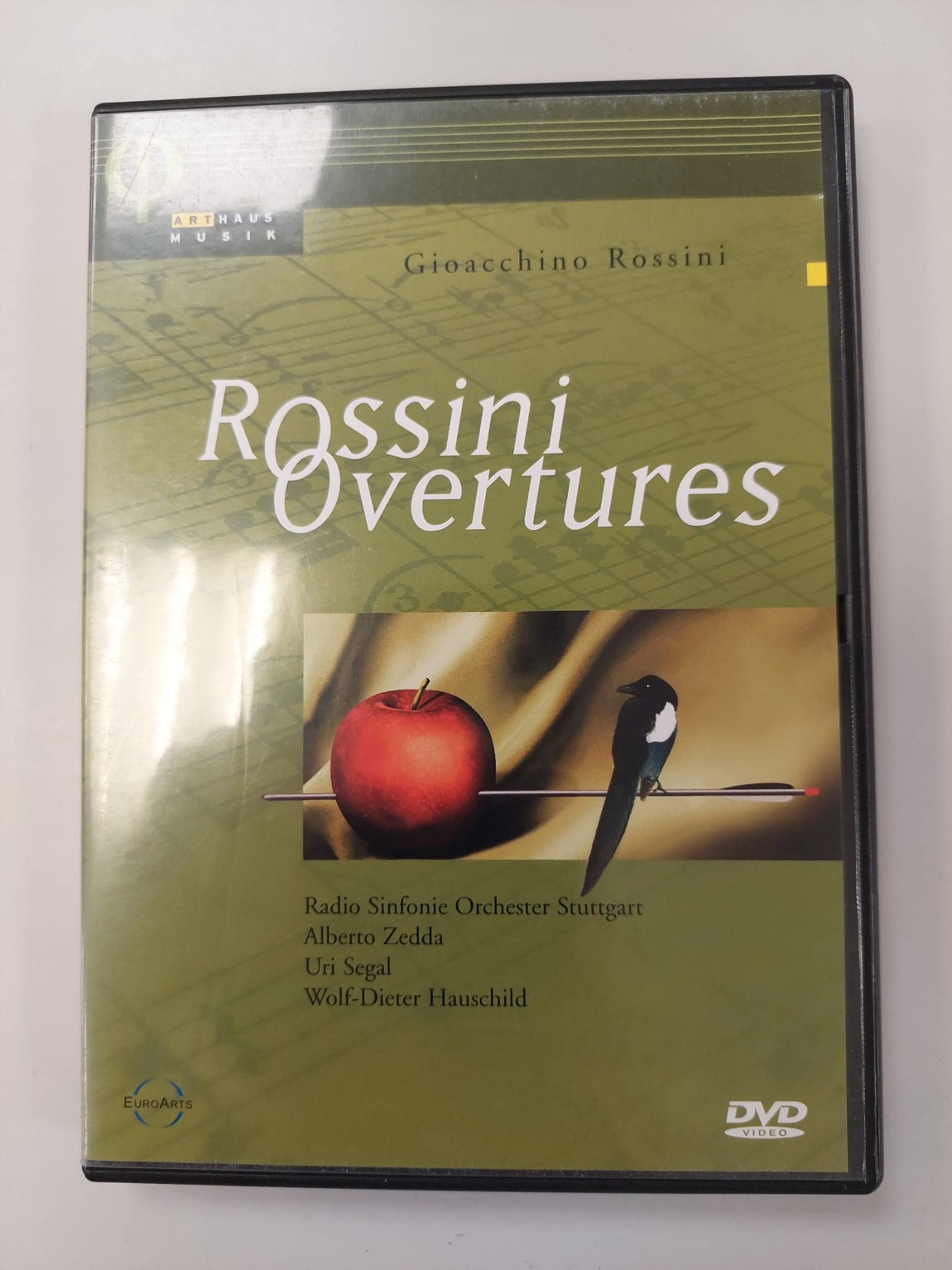
Collected here are performances of most of the familiar Rossini overtures, plus ballet music from 'William Tell.' They are played by the Radio Symphony of Stuttgart under three different conductors--Alberto Zedda, Wolf-Dieter Hauschild, and Uri Segal--and were obviously recorded over a period of several years. All the performances are in the same auditorium but the hall's trappings change from overture to overture. Even more noticeable is that the personnel of the orchestra changes with each performance. And, of course, considering that the performances were recorded over a period of, I would guess, more than a decade, it is odd to see hairstyles and even the ages of the players changing. One even sees the trumpet section change from continental rotary-valved trumpets to the piston-valve kind more commonly seen in American and British orchestras. (And one odd note, something I'd never seen before: in one of the overtures the fourth horn is playing a right-handed instrument!) The Stuttgart symphony is a very fine group; it has no weak departments. Strangely enough it was founded in 1945 by the American military in the immediate aftermath of the fall of Germany. Among its primary conductors have been Neville Marriner and Georges Prêtre. Its current conductor is Sir Roger Norrington, who does not appear here. (I suspect these performances were recorded prior to his accession to the post in 1998, although there are absolutely no indications of the years in which these recordings were made.) All these performances are unexceptionable and in some case are simply magnificent. I would single out the contribution of the cello section in the opening of the 'William Tell Overture,' and particularly the solo playing of its unnamed principal cellist. Additionally the principal oboist in 'La Scala di Seta,' the English hornist in 'William Tell,' the trombones and tuba in 'The Siege of Corinth,' the principal clarinetist in 'Cenerentola' and 'Barber of Seville,' the piccolo and bassoon in 'The Thieving Magpie,' and the violins throughout should come in for especial praise. Among the conductors I would say that whenever Uri Segal takes the podium something a little extra seems to spark the playing of the ensemble, more rhythmic point and dynamic variety. Sound and visual quality are variable, undoubtedly due to the extended time period over which these performances were recorded. Although never objectionable, they do lack the last bit of crystalline crispness in some of the older bits. Camerawork is keyed to events in the musical scores without the frenetic intercutting that so often mars orchestral videos. TT=94 mins. Scott Morrison Read more

Ronnie Earl and the Broadcasters Hope Radio Sessions

Bavarian Radio Symphony Orchestra - Mariss Jansons Beethoven Symphonies 1 2 3

Bavarian Radio Symphony Orchestra - Mariss Jansons Beethoven Symphonies 4 5 6

Bavarian Radio Symphony Orchestra - Mariss Jansons Beethoven Symphonies 7 8 9

Bavarian Radio Symphony Orchestra - Requiem Mass In D Minor Kv 626

Berlioz - Requiem Davis Bavarian Radio Symphony Orchestra and Chorus DVD

RABB DA RADIO

The Ultimate Golf Learning Experience DVD
We use optional analytics and advertising cookies to understand how visitors use Ventari, measure ads, and improve the experience. You can accept all optional cookies, allow analytics only, or decline them. See our Cookie Policy.