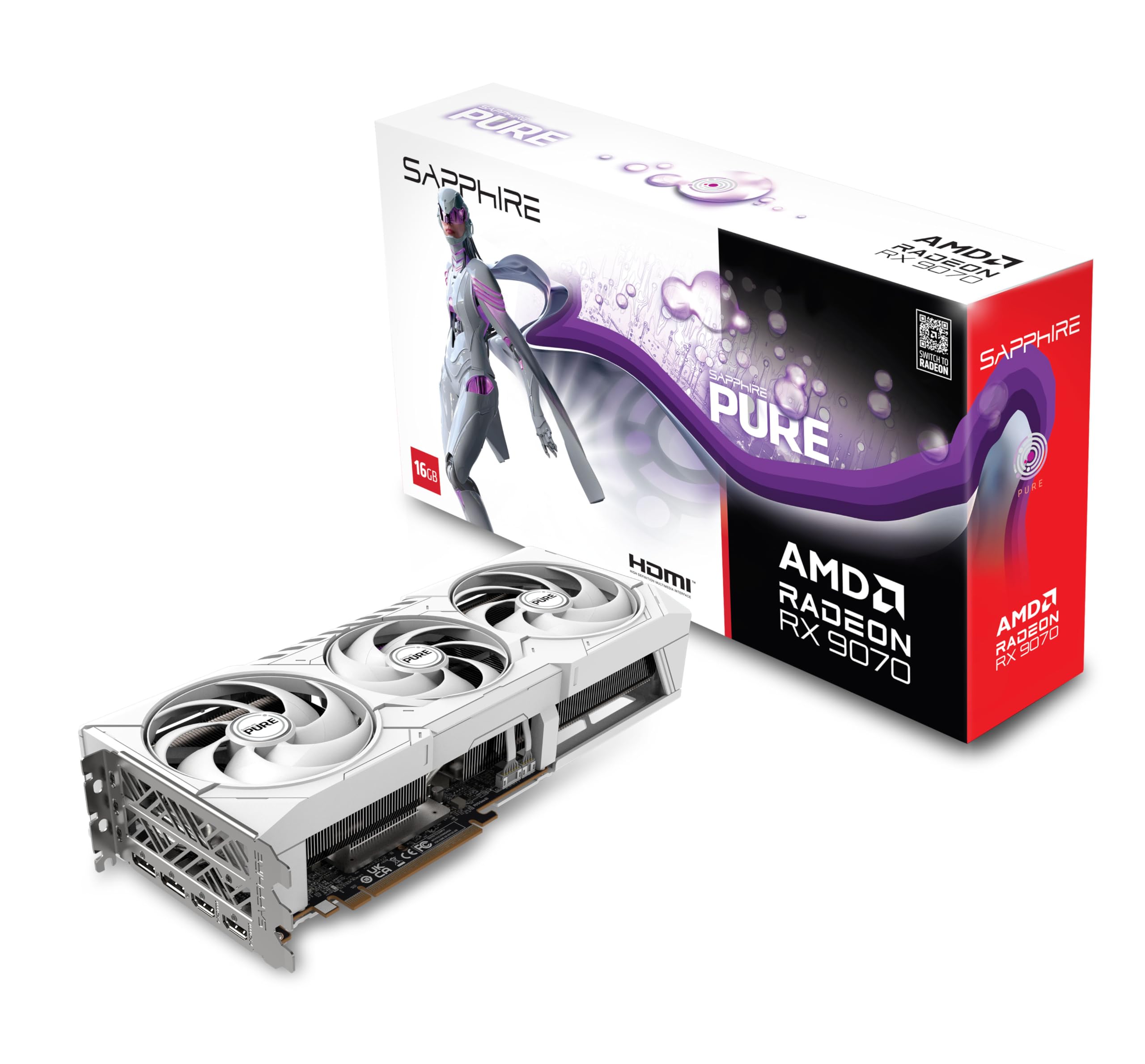


Priorities done right: Sapphire RX 9070
The entire computer technology industry is completely off the rails today, especially in terms of prices and availability, so I’ll leave fluctuations of both aside for this review. Sapphire has done a fantastic job of emphasizing the aspects of their cards that I actually care about, like power delivery, cooling, and build simplicity, and *not* focusing on superfluous features like LEDs, spaceship bezels, etc. This card is no exception, being relatively lightweight for its class, yet cooling very well and looking sleek and modern without being over the top. The implementation of this particular RX 9070 is good if standard. They didn’t try to push the clocks beyond reference, but indeed RDNA 4 doesn’t really excel at that anyway, instead dynamically clocking itself very well based on cooling, power and silicon limits. It does, however, respond fairly well to undervolting, and Sapphire did give you quite a wattage range to work with, if you want. The card supports a cap from 154W on the low end up to 269W on the top end, though its default TDP cap of 220W already seems to be the sweet spot for this silicon under most circumstances. At idle the card is capable of pulling only a few watts, though this is highly situationally dependent. Linux support is excellent, so long as you’re running at least kernel 6.17 and Mesa 25.0 or later, plus the most current kernel firmware available. Ideally Mesa 25.3.x or later for best performance, efficiency and stability, particularly for RT and FSR4 optimization. Hardware encoding and decoding in Linux is great, e.g. via VA-API, allowing for full hardware-acceleration of H.264, HEVC (H.265), VP9 and AV1. Its dual media engine is impressive, often encoding hundreds of FPS of full HD content per second, and is noticeably faster than 9060-based cards at AV1 encoding if that matters to you. In short, Sapphire’s priorities typically line up with my own, and the 9070 is a great example of this philosophy. The card is good-looking without being gaudy, it’s easy to work on, the cooling is very good and the power delivery is reliable and slightly overbuilt. If you don’t care about “Big Green,” “Leather Jacket Man,” and their particular ecosystem, this card is also a better value than their cards on performance parity with this one. Finally, if your CPU supports it, definitely make sure to enable ‘Above 4G Decoding’ and ‘ReBAR/SAM’ support on your motherboard to allow larger than 256MB chunks to be uploaded to the card in one pass. This is a “free” performance uplift of anywhere from 5-20% depending on the scenario, regardless of which OS you’re running. Read more