


quiet, thought provoking
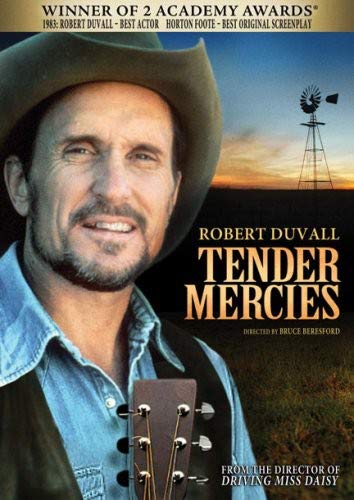
"Tender Mercies" (1983, color, 92 minutes) is one of Roger Ebert's "Great Films." It won Oscars for leading male actor (Duvall) and screenplay (Foote). It had several other Oscar nominations and many film awards. We chose this for our December movie in our "Great Films at the Cathedral" series. Horton Foote wrote this screenplay specifically for Robert Duvall. He'd previously won an Oscar for "To Kill a Mockingbird." IMDb.com's bio of Foote said his "....success can be attributed to his honest examination of the human condition, and why some people survive tragedies while others are destroyed. His central themes of the sense of belonging and longing for home have resonated with audiences for 60 years." And "Tender Mercies" is such a movie. It's definitely not an action film; it's character studies of Duvall and those close to him. Duvall plays the role of Mac Sledge -- a former C&W star, now middle aged, broke, alcoholic. He wakes up one morning in a marginal small motel on the empty Texas plains run by a young widow, Rosa Lee (Tess Harper), who has a pre-teen son. Mac has no money to pay for his lodging so he offers to work it off; she accepts on the condition he not drink. Mac has problems with his anger which alcohol sometimes pacified, sometimes enflamed. Alcohol and anger led to the divorce from his previous wife, Dixie (Betty Buckley), still a famous C&W star, and her prohibiting Mac from having any contact with their daughter (Ellen Barkin). "TM" deals with themes of broken parent-child relations (the widow's son and his deceased father; Mac and his daughter), longing for their restoration, and the building of others. And the gradual development over time and trials of the five central characters. It's a quiet, perceptive movie in which tensions are generated by Mac's desire to see his daughter, his anger, his battle to stay sober, questions about his handling his previous fame and will he sing again. After several months of working for/with the widow, while they're both weeding the garden, Mac says, (IIRC) 'I guess there's no secret how I feel about you. Would you consider marryin' me?' and she says, 'I reckon I would' Typical scenes of the wedding and nuptial bed aren't in the movie -- Foote's got more important issues to present and the story deals with those. IMO, the casting was perfect -- not a single one would be better if replaced by someone else. One professional reviewer said Tess Harper's role as Rosa Lee was weak; I disagree. I thought she was perfect as the young widow, trying to hang on -- insecure and inexperienced in dealing with all that life dealt her -- but trying to use her faith to sustain her. Psychologically, everything was true to life -- no false, implausible notes, and it even includes the realistic, seldom-seen way that problems can cascade through the generations despite efforts to prevent that happening. While some disappointments, tragedies, minor triumphs are experienced, by the movie's end one is uplifted. A perfect movie. Read more