
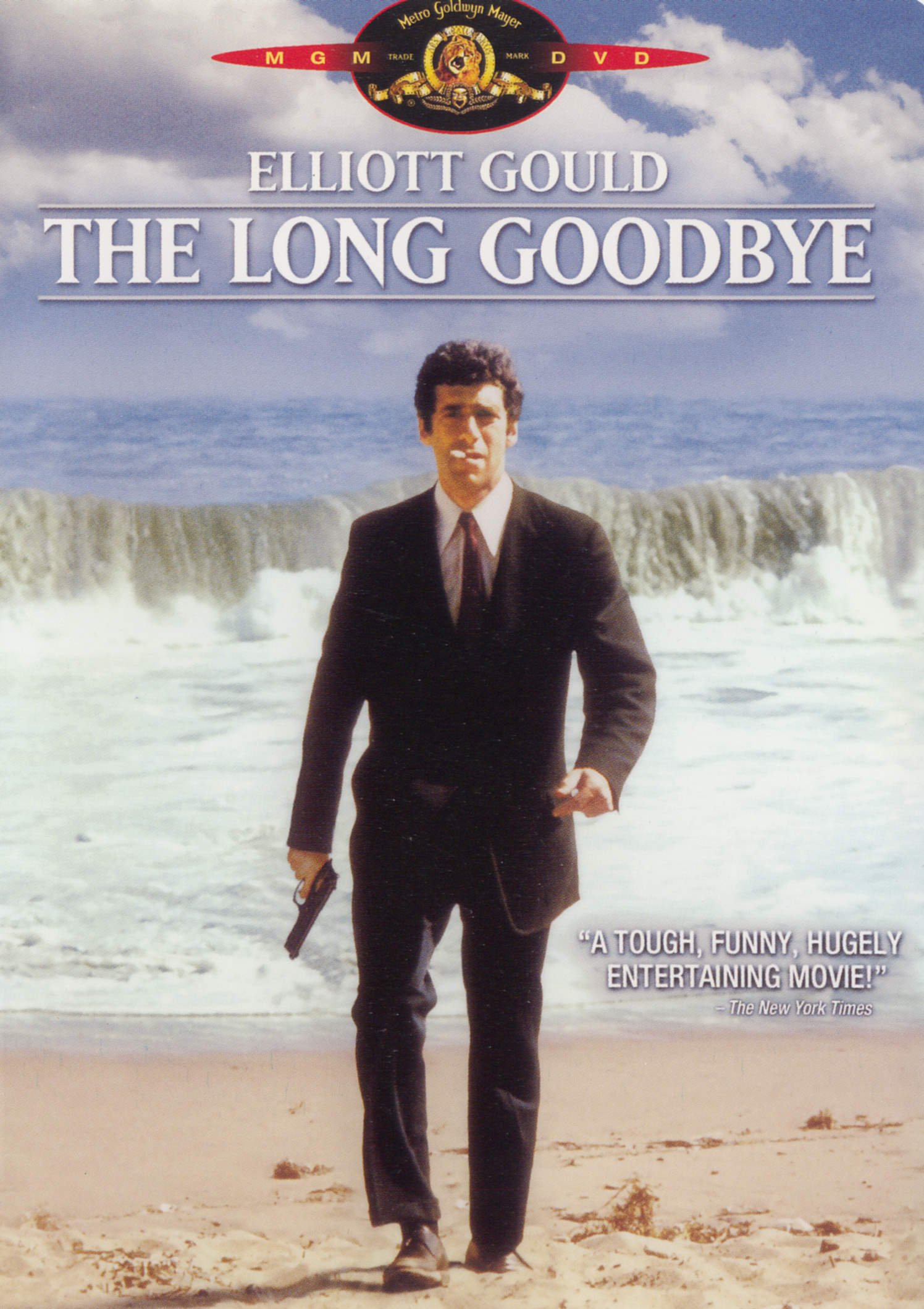
$10.35
Was $14.12Save $3.77

In Stock

Delivery β€” Friday 10 Apr – 16 Apr
Easy Returns Β· 30-day window
This order is a gift

In Stock

Secure Checkout
Free Returns
30-Day Guarantee
Secure checkoutAll transactions are SSL-encrypted. Your payment info is never stored.
Free returnsReturn or replace within 30 days
Fast deliveryOrders ship within 1 business day and arrive in 4–8 days.
Buyer protectionIf your order arrives damaged or doesn't show up, we'll make it right.
24/7 supportOur team is here to help. Reach us anytime by email or chat.
Ships fromOur Warehouse
Sold byJupiter Records
Returns
Easy Returns30-day return window
PaymentsSecure transaction

Product details

GenreMystery & Thrillers
FormatAnamorphic, Closed-captioned, Color, DVD, Dolby, Dubbed, NTSC, Subtitled, Widescreen
ContributorDavid Arkin, Elliott Gould, Greg Carson, Henry Gibson, Jack Knight, Jim Bouton, Jo Ann Brody, Leigh Brackett, Mark Rydell, Nina Van Pallandt, Pepe Callahan, Raymond Chandler, Robert Altman, Stephen Coit, Sterling Hayden, Warren Berlinger See more
LanguageEnglish
Runtime1 hour and 52 minutes

Technical specifications

aspect_ratio2.35:1
is_discontinued_by_manufacturerNo
mpaa_ratingR (Restricted)
product_dimensions7.25 x 5.25 x 0.5 inches; 0.01 ounces
directorGreg Carson, Robert Altman
media_formatAnamorphic, Closed-captioned, Color, DVD, Dolby, Dubbed, NTSC, Subtitled, Widescreen
run_time1 hour and 52 minutes
actorsElliott Gould, Henry Gibson, Mark Rydell, Nina Van Pallandt, Sterling Hayden
dubbed‏ : French
subtitles‏ : English, French, Spanish
languageEnglish (Dolby Digital 2.0 Mono), French (Dolby Digital 2.0 Mono)
studioMGM (Video & DVD)
writersLeigh Brackett, Raymond Chandler
number_of_discs1
best_sellers_rank#54,656 in Movies & TV ( See Top 100 in Movies & TV ) #2,716 in Mystery & Thrillers (Movies & TV) #8,845 in Drama DVDs

Customer reviews

4.5547 ratings

Customers say

Customers praise this neo-noir movie for its superb cinematography and strong performances, particularly noting Elliott Gould's eccentric portrayal and Sterling Hayden's masterful casting.

β˜…β˜…β˜…β˜…β˜…

Rip-Van-Marlowe makes for a great neo-noir movie, '70s style

Barry Guerreroβ€”April 16, 2010βœ“ Verified purchase

It has taken me many years to come around to "The Long Goodbye". For one thing, I was scared off by all of the bad press surrounding Leigh Brackett's alterations to Ramond Chandler's novel. And, for anyone who is already familiar with the novel, how you respond to these alterations will very much be your own personal reaction - there's no denying that. Chandler tended to write rather subtle, inconclusive, or enigmatic endings. Brackett clearly knew that, which is why Hollywood asked her to make the endings to both "The Big Sleep" and "The Long Goodbye", more cinematically friendly in the first place. But unlike "The Big Sleep", where one is still left wondering who did what to whom (and when), there's absolutely no question here as to what happened and why. In fact, if anything, the conclusion to this movie version of "T.L.G." is sort of a precursor to the very shocking ending we see in "Prizzi's Honor" - the main attraction of that shabby little shocker. In other words, the story and its narrative is as air-tight as anyone could possibly want it to be. But don't get me wrong, I still think that "The Big Sleep" is one of the greatest noirs of all time. No, what made me pick up "T.L.G." was something else altogether; something unexpected: the theme music. The music was composed by John Williams and Johnny Mercer. I stumbled across a Youtube excerpt, and there was my jazz hero, Jack Sheldon, singing the movie's theme song. That alone made me want to get this (I collect most everything with J.S.). But, just as with the more famous movie "Laura", the theme song gets sounded throughout the entire picture. However, unlike "Laura", "The Long Goodbye" - that's the name of the tune as well - goes through many different styles and permutations during the course of the film. As a result, the movie doesn't feel like it's just an advertisement for a possible radio hit. The best example of this is in the first of two scenes filmed down in Mexico. Marlowe (Elliott Gould) is trying to get information from the village authorities as to how and when his friend, Terry, allegedly died down there. During the course of their somewhat bizarre discussions, a poor sounding village band plays "T.L.G." tune while accompanying a funeral cortege through the town's cobbled streets. Then we immediately segue to a party scene back at the Malibu Beach home of Mr. and Mrs. Wade, where a few revelers who are crowding around a modest upright piano, crank out a sort of fast, bossa nova rendition of the same tune - almost Brazil '66 like. The juxtaposition of these two scenes and two styles couldn't possibly be more stark and dramatic. It's almost as though the theme song is used as a Wagnerian leitmotif throughout this film. As for Marlowe himself, I think Elliott Gould is brilliant. Much has been made of Altman's "Rip Van Marlowe" approach - a Marlowe who wakes up in a far more indifferent 1970s. Marlowe doesn't know the D.A. here, and the L.A. Police are completely indifferent to him. If anything, he's just a nuissance. They regard him as though he were a doctor who's just a quack. This time, Marlowe has no friends downtown. His credentials mean nothing. But that also permits Marlowe to be more freelance than ever. He's now able to think fully for himself, and is better able to make quick assessments of the situation. This pays off in the end, as Marlowe still clings to his 1940's, good world/bad world values. Given that fact, it's all the more relevant that Mr. Wade - Sterling Hayden - keeps referring to Marlowe as "Marlboro", or "The Marlboro Man" (to his wife). And, of course, the scenes with Elliott Gould and Sterling Hayden are quite famous for Hayden's quick witted, turn-on-a-dime improvisations. He plays a burned out writer who has turned to the bottle in hopes finding some further inspiration - a tired cliche' if there every was one. But Hayden twists this hackneyed theme to his advantage: he's totally over-the-top in the best tradition of the excessive 1970s. These scenes alone are worth the price of admission. All in all, for whatever faults it may possess, there's also an awful lot going for this 1970s, "Rip Van Marlowe" rendition of "The Long Goodbye" ("it's a loooong goodbye, . . and it happens everyday"). Read more

β˜…β˜…β˜…β˜…β˜…

Film Noir and Philip Marlowe. Out of time, out of touch, out of place.

B. Maroldβ€”August 17, 2012βœ“ Verified purchase

I saw "The Long Goodbye" when it appeared in the theaters in 1973, and I was impressed with it then, and the memory of its main events has stayed with me for all these years. So, I thought it was time to dust it off and give it a serious viewing and review. Unlike some other older movies about which I had fond memories, this "The Long Goodbye" did not lose its charm after 40 years. The first thing I recall is that in spite of the fact that this may be Elliot Gould's best performance outside of the film M*A*S*H, I think the stars of the film are director Altman, cinematographer, Vilmos Zsigmond, screenwriter, Leigh Brackett, (relatively unknown at the time) composer John Williams, and a strong nod to the presence of actor Sterling Hayden. They all contribute to the image of a character from New York City the '40s transplanted to Malibu in the '70s. Gould's Philip Marlowe is the film noir gumshoe, but he lacks all the panache of the famous earlier actors who filled that role such as Humphrey Bogart and Robert Mitchum. He has certain skills, but none of the clever competence of the greatest of film noir detectives, Jake Giddes in "Chinatown", who has a nose for incongruities and the talent to hunt them down. Gould's Marlowe seems buffeted about by both the police (with whom Giddes has a respectable relation), who also seem to be caught in Brackett's time warp (no cool Joe Fridays here)and the hoods, lead by a gangster, Marty Augustine, who does seem to have made the transition from 40s hood to 70s wise guy. Situations with both get resolved behind Marlowe's back, and Marlowe has no clue to how that happened. Although Altman may not do it quite as often as Woody Allen, I suspect in this movie he was intentionally copying some of the conventions of "film noir", and making fun of them just a bit. Almost all the interesting stuff seems to happen at night, or in closed rooms where you can't see the daylight. The song, credited to John Williams, sounds just like something which may have been written for an early John Houston film or the film "Laura" which had a famous theme covered by lots of major jazz performers. It seems so utterly not California for Gould's Marlowe to always wear a suit jacket and tie, when all the other characters are dressed as you would expect in 1970s LA. Just as the ending to "Chinatown" is a surprise which I never saw coming, the end to "The Long Goodbye" succeeds in the same way. What seems so puzzling is that there are three different plot lines early in the movie, all of which are connected by nothing except the common location, a gated, exclusive colony of residences on the beach in Malibu. The three plots seem to have nothing connecting them until the last 15 minutes. One benefit of this disconnect is that we can appreciate the role of Sterling Hayden, who, I am convinced, is patterned after the last years of Earnest Hemingway. This and his appearance in "Dr. Strangelove" may be his two most memorable film appearances. However, his appearance here is a nice reminder that Hayden began his career in some notable film noir classics such as "The Asphalt Jungle". The showpiece of Gould's performance is the first 10 minutes, where he is virtually the only speaking character, who does a monologue for the benefit of his cat. Here is were all his anomalies begin, as he puts on a tie to go out to a 24 hour supermarket to buy cat food at 3 AM. According to Wikipedia, the film was not well received at first, but, as I said at the outset, I was immediately impressed by it when I saw it in the theatre. It has one of the prime qualities of a film worth buying. It is rewatchable, maybe once a year or so. The next time I watch it, I would be especially attentive to whether there are early clues which tie the three plot lines together. By the way, even though his role is uncredited, you can't miss Arnold Schwarzenegger as one of the gangster's "muscle". David Carradine also has an uncredited role, but he is less easy to spot. Read more

Recently Viewed