
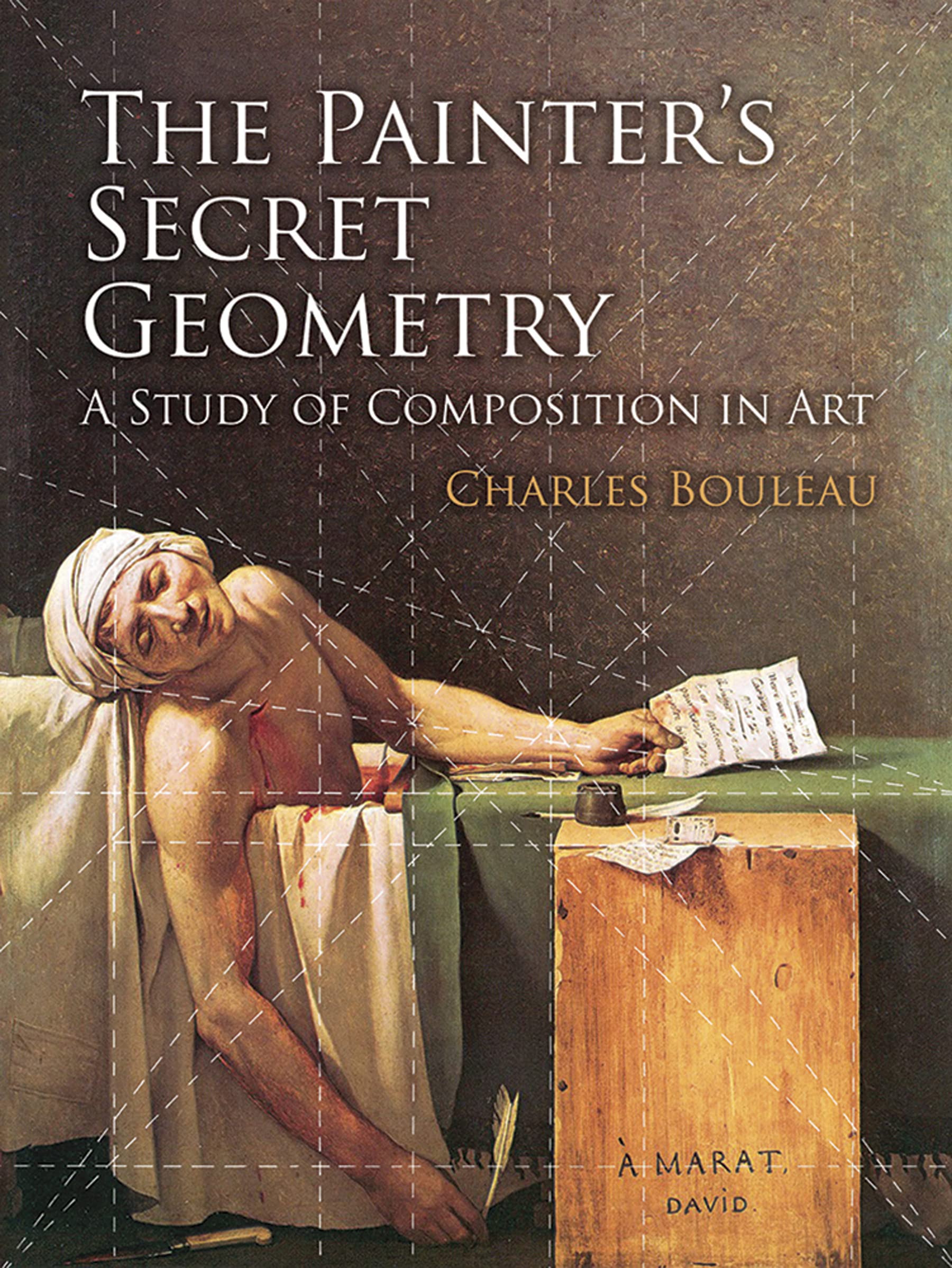


Any European Art History Course Without This Book is Not Worth Taking
Update, 4 August 2014. It is impossible to overstate the importance of this book to the studies of art history and 2-D drawing and painting instruction. This book certifies beyond reasonable doubt that the "intuitions" of the great European masters and well trained artists into the 20th century incorporated a healthy dose of geometrical technique to organize their image spaces harmoniously. Organization did not dominate their images; organization was one of the components of how they conceived, evolved, and finished their works, along with their subjective sensibilities, which so many artists today claim to be sufficient. The lack of knowledge and understanding of images' structural organization is apparent in just about any art-crit or art history writings or lectures, whether it is Max Kozloff, Meyer Shapiro, or any other of the multitude of such "experts." And if they know such material, why do they fail to communicate it as part of their discussions and analyses? Before going into further detail than in the original review, let me make a comment about the Dover reprint. At the retail price of $21.95, this is nothing less than a steal. It is a near facsimile of the hardback edition by Harcourt from 1963. The same size, the primary difference is the lower contrast of the illustrations on Dover's relatively uncoated paper. But there is nothing less useable about this printing than the original. Bouleau starts with a look at the precursors to easel paintings, what he calls monumental art, done on the surfaces of any number of shapes and surface geometries of churches, palatial homes, public buildings, etc, primarily in Italy. Practitioners had to have been masters of applied geometry to have gotten right to the observer's eye the distortions necessary for convincing renderings. He then considers the constraints a frame imposes on the emergent image's or sculpture's content and form. In this chapter he introduces and analyzes several historically important constructions, including the armature of the rectangle and rabatment of the shorter sides of a rectangle, two of the most commonly used structures and their variations over several centuries to the present. The other chapters are arranged at times chronologically and others by the technique within the chronology. Starting with the geometric structures used during the Middle Ages, he progresses to the musical consonances, to the curvilinear and linear types of dynamic compositions, applications to depth rendering, and on to 19th and 20th century artists and their work. Let's consider just three from among hundreds of examples of why a knowledge of structure and ability to perceive it in an image deepen one's understanding of an image and of the artist's possible intent. Bouleau spends a lot of space on Seurat, culminating in an analysis of "La Grande Jatte," at the Art Institute of Chicago, publisher of the outstandingly detailed book, "Seurat and the Making of La Grande Jatte." Conservators found tack holes around the frame of a 6 x 4 grid; the aspect ration of the painting is 2 x 3. While the book goes into detail about how Seurat might have used the grid for this and that, it does not at all consider the other organizational potentials of a grid. Bouleau makes an insurmountable case that Seurat used not only grids, but far far more sophisticated geometrical ways to organize his images than simple grids of squares might lead one to imagine. My second example is Meyer Shapiro's "analysis" of Mondrian's work in his essay, "Mondrian" in his book of selected papers, "Modern Art" compared to Bouleau's revelations about how Mondrian actually structures "Painting I," "Broadway Boogie-Woogie," and "Composition with Two Lines.' The former tries, with probably good reason, to tie these works to 19th Century and other artists' earlier works for inspiration and even organizational hints, but one's appreciation of the geometry of these works is completely unfulfilling. It takes Bouleau's insights to grasp the depth of the genius behind these images. For a third example, there is Botticelli's "Birth of Venus," her lean giving a viewer much about which to wonder, a pose that would tip a coracle, let alone a half-shell. Some play with L B Alberti's reverse musical consonances supplies the likely answer. And so many more over more than six hundred years of productive genius. These ideas and analyses Bouleau did not pull from the ethosphere. All of these geometrical ideas are documented by artists about their own working methods and by such as Da Vinci, L B Alberti, G P Lomazzo, and numerous others, whose writings have been used by generations of artists, sometimes over hundreds of years. Other documentation includes artists' known studies and sketches and examinations of the finished works. More emerges constantly with new technologies and studies of works, such as on the Seurat painting. Obviously, my point here is that without a detailed understanding and grounding in artists' various structural techniques, one lacks a major part of being able to make, view, understand, and appreciate images. This book should and could serve as a basis in every college's and art school's programs for at least a one semester course on these topics. Homework is so easy to conceive it doesn't bear mentioning. Another project of worth for this and all other art books of merit would be to build DVDs of the black-and-white illustrations, but in color. Such a DVD accompanying Bouleau's book might show not only color renderings of his findings, but also suggest other images for readers to solve on their own. This book's material could also serve as the core of a joint undergraduate Arts department - Math department course for arts students and math nonmajors that could be lots of fun. Any person involved in the 2-D visual arts should get this book and digest its lessons. Even photographers, for whom direct applications of these techniques are not always immediately clear, will benefit from inculcating these methods into their own mental image databases to assist their eye in recognizing new possibilities to exploit in the studio or when moving quickly on the street with small format cameras. For anyone, knowing this material cannot fail to add a rich new dimension to one's viewing and enjoyment of the 2-D visual arts. Interestingly, the preeminent geometric technique currently touted among photographers and, even, painters, the infamous Rule of Thirds, does not appear anywhere in this book. Thus far, I have not seen anything anywhere that hints at the origin of this "rule." I have some speculative ideas, but that is it. Original Review, 23 March 2008: This is the art history text we all should have had and didn't. It is the only book I have found in several years of looking into what has been printed on composition/design in the 2-D arts that actually shows the manner in which artists in a number of Greco-Roman to western traditions managed their space. It was certainly not the "I'm OK, you're OK" approach that is so common now. The great ones then, and to a certain degree even now, were very well educated in their traditions, which included mathematics, especially geometry, the application of which to image making was connected to their faith, as well as being an expression of their genius. Bouleau's argument, in fact, does not find the "Golden Section" as the sole structural basis for space management over the centuries, but is one tool among many techniques that yielded harmonious spacial divisions that became the abstract structure of images. Though a structure might be geometric, complex or simple, artists found infinite variety in the possibilities, not infrequently of similar structures, over many centuries, styles, fashions, and traditions. Bouleau carries his argument into the 20th century and shows that respect for geometric spacial division to establish harmony is not dead. It still works, even with completely nonrepresentational art. This is a stunningly informative look at the visual arts in the European traditions and is the only book I have found that informs me on how the "old masters" and some contemporary masters built their paintings. Geometry was part of their art, and they KNEW their geometry. How many arts majors today are skilled in mathematics through algebra III and geometry? All too often, majoring in the arts is a code word for not doing well in the maths or disliking quantitative studies to the point of finding a major that doesn't require classes in the maths. Interestingly, one of Bouleau's geometric techniques involves ratios derived from the musical arts. Today, even, many commentators will acknowledge that musicians tend to be stronger than average in the maths. When has any reader heard such an asserion about practioners, historians, or critics of the visual arts? It is probably a stretch to be able to apply much of this to photographing, my pet passion. What Bouleau reveals here requires deliberative time, not the quick visual assessments necessary in small format photography. But this reviewer asserts that the more a photographer knows about image structure, the more sure he or she is likely to be in using the viewfinder when the time comes. This is an outstanding book that never should have been taken out of print. That it is says much to me about what is not taught to today's image makers, either drawing/painting, or photography. Read more