
An Important Milestone in the TV Revolution
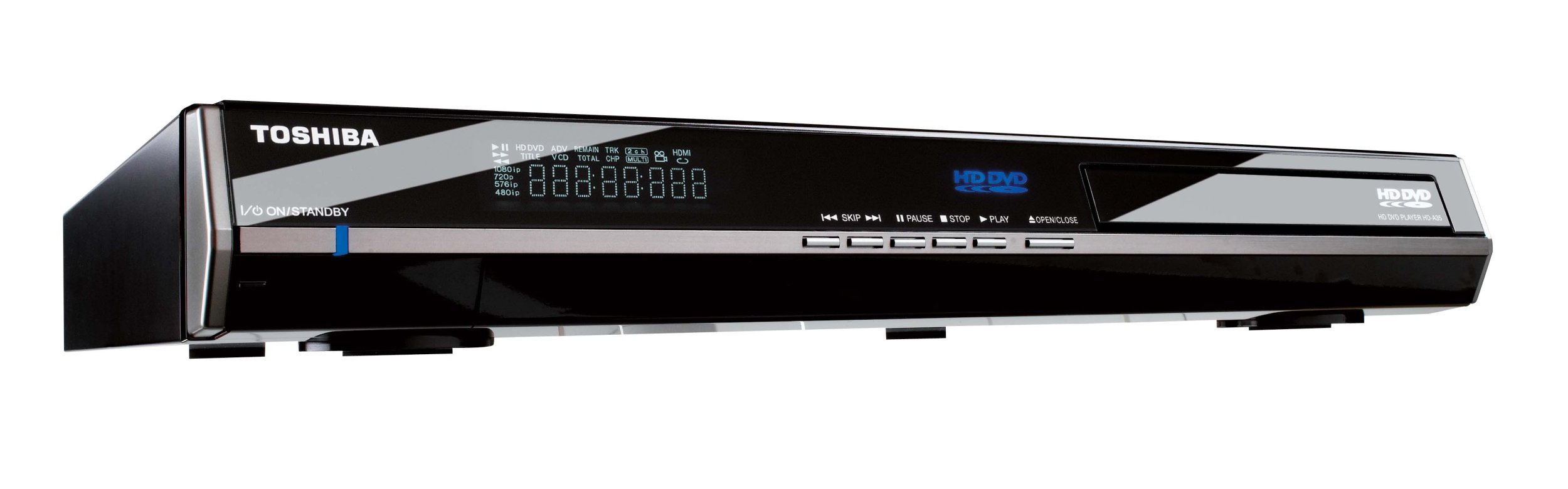
I've only had this thing for a couple of days, and have been absolutely blown away by the video and audio quality of the two HD-DVD movies I've watched thus far: Sahara and Goodfellas. Both the picture and the sound (when the player is properly connected and properly set up) are far superior to that of DVD when viewed on a high-definition TV. For video, I set the output to HDMI and the resolution to 1080i (even though my TV is an older 720p model). A supplemental sheet that comes with the manual recommends that, for HD-DVD discs, the resolution be set to the native format of the disc rather than that of the TV. Every HD-DVD I've read about thus far is encoded at 1080-line resolution, so I set the player at 1080i. I haven't yet noticed anything in the manual regarding what to do for regular DVDs, so I experimented a bit and concluded that 1080i is the best setting for DVDs as well. Thus, I set the thing at a resolution of 1080i and plan to leave it there. I connected the player to my TV's DVI input using an HDMI-to-DVI adapter, then connected the six analog 5.1 audio outputs on the back of the player to the analog 5.1 inputs on my stereo receiver, then calibrated the audio for speaker size and distance using the "Setup" feature. Note: The owner's manual doesn't mention that the "Setup" button is hidden under a sliding panel on the lower end of the remote control. My only complaint is that the remote control is an un-backlit version of the backlit remote that comes with the more expensive HD-XA1 player offered by Toshiba. The only way I can read it is with a flashlight. Fortunately, once I got things figured out, I found that I really only need to use a few key buttons, the positions of which are easily memorized. Also, there ought to be a label on the sliding panel that hides the setup button. The menu of an HD-DVD disc can be accessed and operated while the movie is playing. This is much cooler than it sounds. The features that can be operated from the menu are much more sophisticated than those on a regular DVD. Picture quality is phenomenal, even on my 42" 720p LCD rear-projection TV (a 3-year-old model that's already antiquated). It's obvious that HD-DVD is designed to be optimatlly viewed on a high-quality big-screen 1080-line TV (at least 60") in order to achieve a true home-cinema experience. I calculated that the ideal TV for my living room (viewing distance = 12 feet) would be a 65" screen with 1080-line resolution. The picture quality is even better than what I get from HD satellite and broadcast channels. I could detect no video-compression artifacts in either of the HD-DVDs that I've watched thus far, even in scenes with lots of complex high-speed motion. In addition to extreme picture clarity, HD-DVD offers a very noticeable improvement in color gamut over DVD. Watch an HD movie, and you'll see real-world colors you've never seen on TV before. Once I switched back to watching a regular DVD, the color seemed a bit phony-looking. What really caught me by surprise was the quality of the sound when using the Dolby Digital Plus soundtrack. Right now, the only way to listen to the DD+ soundtrack in its pure form is to connect to the analog 5.1 outputs on the back of the player, which involves a bit of extra cabling. It's well worth the trouble, however. DD+ apparently allows the use of a much lower compression ratio than ordinary DD or DTS. The surround effects are much more like those you'll hear in a good theater, and the realism and clarity of the sounds is absolutely electrifying. You can, alternatively, connect to your receiver via digital optical cable, in which case the DD+ track gets converted to ordinary DTS (possibly losing some of its quality in the process). We're in the midst of the TV Revloution, with a combination of new display technologies, new audio/video formats, and new audio/video media. The biggest problem has been the scarcity of HD material to watch on your HD television, and the lack of pre-recorded HD media (the obscure D-VHS format having been the only option until now). It will probably be quite some time before a sizeable portion of the cable/satellite/broadcast universe converts to HD. Even the local ATSC digital terrestrial broadcasts in my area are still standard definition much of the time, and my HD satellite programming package only provides me with 3 full-time HD channels and 3 channels that are mixed HD/SD. HD-DVD and BluRay discs could enable people to gain access to a lot of high-quality HD material while we wait for the cable/satellite/broadcast industry to catch up. After that, HD discs will be able to fulfill the same function that DVDs and VHS tapes currently provide, enabling you to own or rent a wide variety of programming for viewing at your convenience. Now that I've watched a couple of HD-DVDs on my HDTV, I may never want to buy or rent a regular DVD again (even though, admittedly, the HD-A1 does a very nice job of playing regular DVDs). Sales of HD players and discs could also drive sales of big-screen 1080-line TVs as well, as this is the only type of TV that would enable the home-theater enthusiast to really take full advantage of what HD-DVD and (theoretically) BluRay have to offer. Read more