


Nice unit.
This has enough power to take care of most any vehicle you may need to "jump" start. Read more
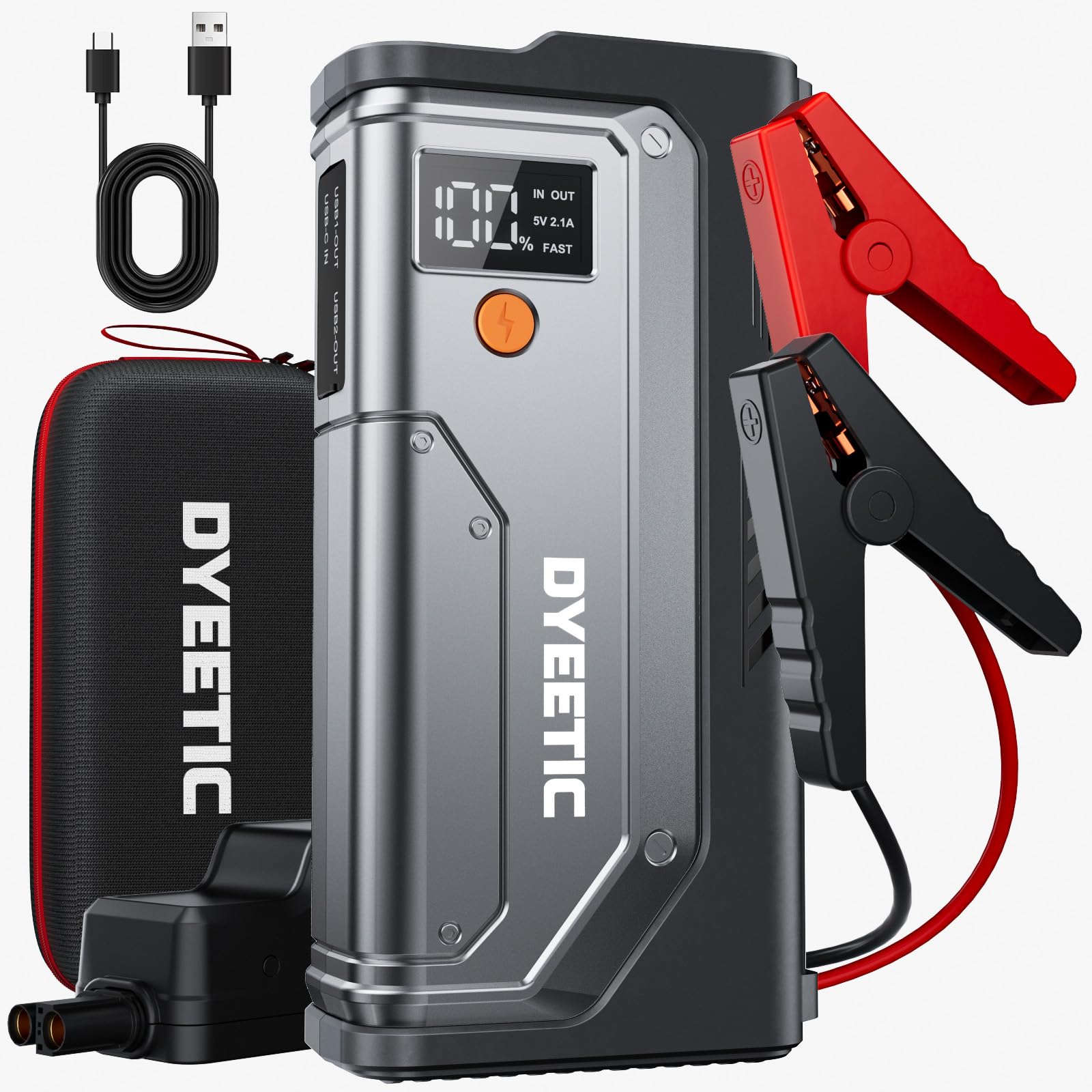
Dyeetic
$71.99
Have a question about this product?


Product video 1
Customer summary is not available yet.
This has enough power to take care of most any vehicle you may need to "jump" start. Read more
Great price, I expect it to work fine. Will update review if it fails. Read more
Being a battery and electrical engineer, such products I enjoy reviewing because I get to push them to their limit with equipment most don’t have access to. And this product was no different. My first question was, “what’s in this box attached to the jumper cables”. And as any good engineer, I immediately took it apart. Inside is basically a microcontroller and a 70A relay. I already knew the 5000A claim was bogus, but the hardware being rated to only 1.5% of the claim? Ouch! So now it’s a question of how hard are they overdriving their hardware? For the life of me I tried to open the battery itself, but I had no luck, without being willing to destroying the housing. So this is basically thrown away when dead, yuck! Probing the voltage, output is about 16v without the stereotypical SMPS (switch mode power supply) noise. So the battery is 16v? Looking at the characteristic discharge profile, it’s some type of Li-ion, meaning a 4S configuration. Do note that at the top of charge this thing can push to over 16.5v, so make sure whatever your trying to power off this battery can handle it (most automotive stuff can, but you’re approaching the limit). The thinking here is to have a large voltage delta to push more amps (this at 16v and your low battery at 9v means a delta of 7v, divided by the resistance gives you the potential current). Ok, time to put a huge load on this thing. Grabbing a “ready for the garbage” flooded lead acid battery, I put it into my S2000 and tried to start it using this. The struggle was real, but it started. So this working with an old V8 (the engine adds extra load, but those older cars don’t have reduction gears on the starter, meaning they pulled a ton more current) is a stretch. Ok, now it’s time to take this to the electronic load. The load I have will discharge at up to 6,000w with a max current of 125A (120A is its rating, but you can slightly overdrive), and I can set a min voltage. With Vmin set to 9v and Pmax of 6000w (again, 125A is the limit), I connected a tiny battery, drained it to 9v and fired this jumper up. Results were the maximum of 125A at 10.97V (1,372w). The jump battery started at 100%, and apparently it had some legs still left in it. Just want to say “poor relay” real quick, but let’s continue. Now, let’s see what protections we have. I continued to push the “force charge” button (have to reset every attempt) until the thing locked out. After 3 solid attempts, I got the E3 error (>65C, basically too hot to discharge), which was the overtemp protection. Boy was the battery case toasty, lol. I then attempted to charge to see if it would lock it out, and pass, it did. I’d say it was a good 20 minutes before it started throwing the E2 fault instead (overtemp charge fault, charging with Lithium batteries is restricted to a lower temperature, 45C). I can’t verify the accuracy of the thermistor, but the right things appear to be happening. Once things cooled off, I fully discharged the battery using a USB load, and performed a charge capacity test. Results, 54.58Wh. Assuming a 98% efficiency conversion (optimistic, I know), just north of 50Wh of battery was measured. Here’s where things get weird. The listing states 26.8Ah, the battery states 16.8Ah, and capacity testing is showing 3.7Ah. I never get the need for manufactures to inflate battery figures! So this thing is capable of a 30C discharge. That’s not bad, but not impressive. There are cells out there that will do 100C (100x their capacity in amps). But at the price being asked, the performance is reasonable. I knocked it a star for the shear boating of the performance figures. The cell is incapable of giving 5000A (even if you took all 4 and put them in parallel, still ain’t happening), even shorted out. The capacity figure isn’t listed correctly anywhere either. But it’s capable of jumping a normal car, comes with 2 USB ports and an ok light. How long this battery will last is of concern if you’re jumping cars regularly. But for the cost, it’s a good backup incase things go south. Just be sure it’s checked regularly for charge state, and top it off often incase that situation comes to bear. Not a bad product. Read more


As a shade-tree mechanic who's turned wrenches on everything from cars to pickups to heavy equipment for years, I gotta say this little portable jump starter is a solid deal, especially at the sale price point. It lists for $99.99 list, but snag the coupon and you're only out about $60— that's basically stealing it for what you get. First off, the build quality is on point. The zippered carrying case has a pretty rigid shell—feels tough enough to bounce around in the back of a service truck without getting beat up. The zipper glides smooth and it's a nice padded setup inside. Pop the case open and you've got the unit nestled in a fitted, cushioned spot on one side so it doesn't rattle. Opposite is a mesh zip pocket with the heavy-duty jumper cables, USB-C charging cable, and the manual all tucked away neat. There's even a padded divider strap in the middle to keep everything from banging together in transit. Organization like that matters when you're digging for tools at 2 a.m. on a dead battery. Came in at roughly 80% charge out of the box—just hit the power button and the LEDs tell you straight up. Hooked up the included USB-C cable, topped it off to 100% in no time. They claim "ultra-low" self-discharge with a legit 2-year standby. I've had it sitting a month now and it's still holding full—impressive for lithium gear that usually leaks like a sieve if you forget it. Long-press the start button and the built-in LED light kicks on up top—bright enough for fumbling around under the hood in the dark when you're hooking up clamps on a dead battery at night but it is not a replacement for a real flashlight, don't get me wrong. The clamps feel decent—solid connection to the posts—and the plug end snaps securely into the unit. They seem to be made of a fiberglass-reinforced plastic of some sort. These jump starter boxes are super simple to use; just clamp to the battery positive terminal and the negative to a ground like normal, plug into the pack, and crank. Fires right up (assuming it's sized right for the engine—I've used similar ones on smaller diesels and gas rigs without issue, though big boys like a 6.7L might want something with more peak amps). Beyond jumping, it's a beefy portable power bank too, weighing in at only 480 grams. Dual USB-A outputs handle charging phones, tablets, or running small 12V stuff. Kinda wish it had a USB-C out but it gets the job done, I just threw an extra adapter I had on hand into the case. I've currently got it staged in the trunk of my wife's car ready to go in case the battery dies unexpectedly on her. Everything seems built tough so far—no cheap plastic feel, connections are secure, no weird heat or smells during charge/use. Durability is the real test over time, especially that 2-year standby claim, but initial impressions are strong. Bottom line: I'm happy with it. For the money, it's a no-brainer to throw in the toolbox or under the seat. I'd hand one to another wrench or a buddy without thinking twice. Read more


5000A Portable Car Jump Starter with Air Compressor 150PSI Car Battery Jump Starter 10 0L Gas 8 0L

7000A Jump Starter 12V Car Battery Booster Pack All Gas 12 0L Diesel Car Starter Smart Jumper Cables

M1 Car Battery Jump Starter with Air Compressor 4500A 150PSI 9 0 L Gas 8 0L Diesel Portable

Professional-Grade 7000A Peak Car Battery Jump Starter All Gas 10L Diesel 5000A CCA Portable Car Jump Starter Battery

FRAM FEK40008 Car Battery Jump Starter 12000mAh 44 4Wh Up to 5 0L Gas and 2 0L Diesel

UTRAI 5000A 150PSI Jump Starter with Air Compressor 12V Portable Jump Box All Gas 10L Diesel Jump Pack

UTRAI 8000A Portable Car Jump Starter 12V Battery Jumper for All Gas 12L Diesel Engines 27000mAh Jump Box

UTRAI Jump Starter with Air Compressor 6000A Peak Battery Jumper Starter Portable All Gas 10 0L Diesel with
We use optional analytics and advertising cookies to understand how visitors use Ventari, measure ads, and improve the experience. You can accept all optional cookies, allow analytics only, or decline them. See our Cookie Policy.