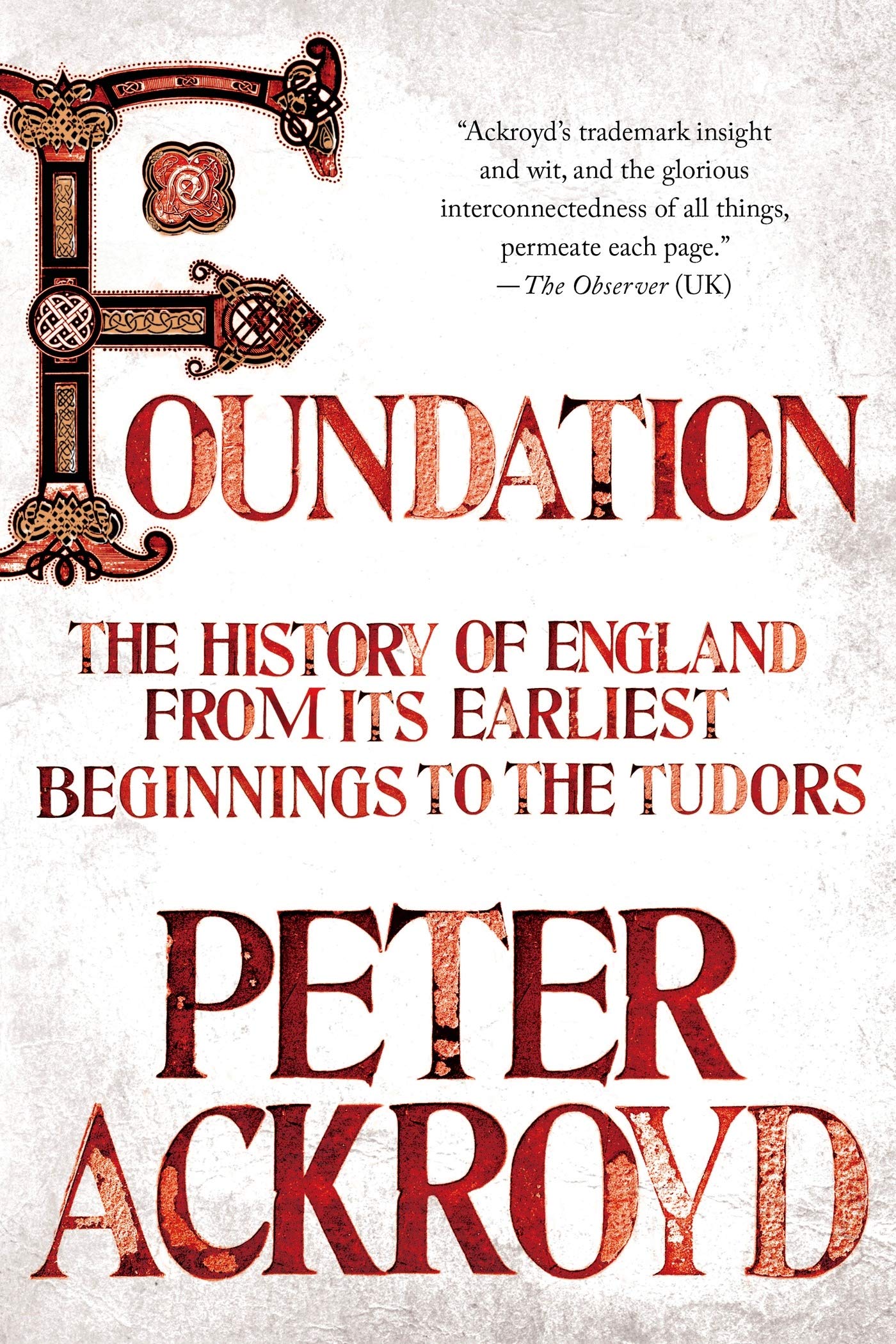
I did not intend to read these three volumes in reverse order, but when I finished the book on the Glorious Revolution, I went to the book on the Tudors, and you can see where I ended up. In a little more than 400 pages, Ackroyd takes us through the earliest beginnings of England, the 13 kings of the Plantagenet dynasty, through Richard II and III and ends us with HenryVII, which sets up his next work on the Tudors. I enjoyed the book, the author's writing style, and the way he was able to keep it all flowing without losing my interest. Having read other works on English history and now this three book set, I have a much better understanding of a slow and often painful process that developed into England as we know it. Every king was unique and some much more effective than others, but the essence of this period is that kings wanted to make war to prove their strength, they had to deal with lords who were jealous of their power and wealth, marriages were arranged with the hope of creating new alliances, a male heir was imperative, the church was very powerful and death by plague and sundry disease lingered around every corner. And, through a period of about 250 years, you see King John sign the Magna Carta, Parliaments which did not sit in regular sessions never the less began to deal with law and legislation, and customs began to be established many of which were the ground of common law as known today. There is criticism of the book because of the total lack of a bibliography and extensive notes to cover everything imaginable. I dismiss these aspersions. This book is written to provide the general reader somewhat of a background. As a reader, if you find something of particular interest, you can find a host of other books that deal with that person or subject in much greater detail. You simply cannot cover this much time and these many reigns and all the appropriate baggage of bishops and relatives and do so strictly in a pure academic fashion, so I would suggest the critics just back off. I have a fine book, of fine print with complete notes and bibliography that covers one king of the Stewart dynasty in Scotland.. and while this book is a masterful academic study, I have never been able to get through it. I suppose if a doctor told me I had a terminal disease and only enough time to completely read this study, I am quite sure I would live another 25 years. Peter Ackroyd is not that and I expect he never wants to be, so I will keep on buying his books. I read them and enjoy them. Read more
I have already read Tudors & Rebellion by Ackroyd, which are excellent. Foundation is not quite at the same level. I think it should have been two separate books, the first covering English history up to the Plantagenets, then the second covering the Plantagenet era. Foundation reaches the Norman conquest on page 90, so there was only space for the briefest summary of the Anglo-Saxon era. Six centuries are crammed into 40 pages. When it comes to the Plantagenets, important people such as William Marshall are not mentioned even once. I think that Eleanor of Aquitaine was mentioned a single time in passing. So... Foundation is not quite as good as what I had hoped for. If this era of English history is what you want to learn about, I'd recommend reading Plantagenets & The Wars of the Roses by Dan Jones instead. Read more
I wish I were eloquent enough to adequately praise this book, but I'm not so I'll have to stumble through its attributes in my own prosaic way. First off, the beginning of the book bogged down a bit for me, as it went far back into the Stone Age. It was interesting, but that period of history is not wholly in my realm of interest, as so much of that history is speculation as there were no written records of any kind. Once I got through that and began reading about the earliest "recorded" history of England, I was hooked. What I most enjoyed about this book was the reading style. It was not academically-slanted, but it truly seemed to be aimed at the general populace. I remember so many college history classes in which battles were laboriously described. The worst ones were the battles that went on for weeks, as then we'd have to read of how each army was lined up, where their flanks were arranged, who rode in first, where the first man fell, day after day, etc. That stuff is not what intrigues me. I prefer reading about the life of the people... not the battles of its armies. Ackroyd had a lot of battles to cover, as any history of a nation is really built upon battles and land seizures and cessions, but Ackroyd mercifully handled them in a nutshell.... sort of like "9,000 men met 6,000 men... they came, they saw, they conquered." Or, they lost. So, we knew who the major players were in these confrontations, and where they took place, but we were spared the minutia of every detail. As Ackroyd progresses through the centuries, he not only adequately describes each new monarch and his court, but he also brings in collateral English history. For example, he talked about drastic climate changes as they occurred in the first 5 centuries BC and also during the 11th and 12th centuries AD and how these changes affected not only the economy of England, but it's people as well, and how times of exceptionally poor harvests raised the body count and ushered in epidemic diseases and crime rates. Reading this book has confirmed by previous opinion that the entire history of Man is simply one of seizure and abuse. Throughout all history, and quite evident between these pages, 99% of the people in this world have been considered expendable and simply a means to an end by the 1% ruling elite. Whether that ruling elite was simply an early man who gathered others about him to pillage a near-by village, kill its inhabitants and take over the land in order to increase his own holdings and stature, or the leaders of today's nations who ignore their poor and hungry because all that matters is their self-aggrandizement and personal luxury, mankind's entire history has been formed by one group warring against another in order to satisfy some personal lust. To summarize this book, I would say that it is an easy-to read tome, full of information not only about the kinds of England, but also about some of the daily life. What toys children had, what games men played, what foods they ate, what jokes they played on each other, and so much more. It's not a "dry" history. But history is certainly covered! After reading it I felt that the entire system of "monarchy" in England was (and is), simply a crock. These rulers simply never cared about the welfare of anyone other than themselves. They wanted power, riches, fame. They considered the unlanded serfs and slaves so beneath their dignity as to not be worthy of a thought. These kings felt they "deserved" to rule by some incredible gift of divine right. They murdered, they connived, they deprived anyone at all of their land and welfare in order to promote their own personal sense of worth. Honestly, after finishing the book, it simply boggled my mind that the English put up with it at all, much less to the present! If you like history but don't want an academic book that might be required reading on your way to becoming a PhD in history, then you'll love this book. If you've heard of the Plague, the houses of York and Lancaster, the Hundred Years War, the War of the Roses, the Plantagenets, the Hanoverians, Angevins, Normandy, or the Tudors, then you'll find those topics adequately covered. I am looking forward to reading the further volumes in this series! Read more
I am, an admitted, anglophile, but I couldn't get enough of this book. Ackroyd's method of conveying historical content, intertwined with historical setting and humor, is masterful. This history reads like narrative and is thoroughly engrossing, pulling the reader in to the world of Medieval England. Ackroyd does an excellent job showing the interconnectedness of English history, demonstrating that history is not a straight line, but is rather a winding road that is worth being travelled. An easy four stars. Read more