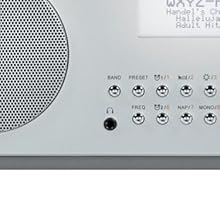
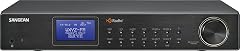
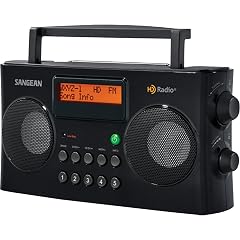
The short summary is: If you don't have up-to-date HD FM with 6-lines of RDS information display, you want fast switching between more perfectly tuned stations than you thought possible, and can accept the fact that its high-quality mono speaker sounds really good, buy this HDR-18! If you must have true stereo all the way to the speakers, and whatever level of audio excellence you like, get the Sangean HDT-20 tuner and connect it to your audio system, because as far as I can tell, it has the same superb tuner, display, and features as this HDR-18. If you want great interactive FM listening, because no single station always plays what you want to hear, but not necessarily the perfect bedroom clock-radio, the HDR-18 is more like the most-excellent kitchen radio. If you want your favorite music in the bedroom, you probably want to be pressing some different kind of buttons than the hard-to-read buttons on this radio, and the display is lighted-background with dark lettering, so if it doesn't keep you awake at night in the bedroom, I'm guessing your partner will want to dim it to the point of not being able to read the clock. I use this HDR-18 in the kitchen, where I want quick station-switching between lots of stations and detailed RDS display at a glance, and I absolutely love it! It doesn't get my favorite AM station, and only gets 1 HD AM station I don't like, but that HD AM station has perfect reception, so maybe there is hope for better AM stations in the future. I connected an external AM loop, and I suspect maybe if I installed a good Ground wire, maybe the HDR-18 could get my favorite AM station, but I use my old Portable Sangean PR-D5 for that, and I found a particular spot in my house where that station comes in well. The included FM telescoping rod antenna might get you the stations you want, but you may want to do some work removing it with a 7/16 open-end wrench and replacing it with the Amazon-recommended F-connector-wire-Dipole antenna, mounting it high and away from where you are, and fussing with the exact placement of the connecting wire in order to achieve the stellar reception I did, but Wow it was worth it! I also discovered that connecting a well-made 3.5mm audio cable to the Aux-in jack and coiling it up near the radio allowed fine-tuning the reception by slightly tweaking it's position and coil diameter; this locked-in my favorite weak FM station without losing any other stations. Even an inch difference in the placement of that cable makes a difference, but once set, you don't need to move it again. I'm only giving the HDR-18 4 stars, because plenty of improvements are possible, but where it really counts, the reception, display information, and sound quality are so outstanding you should definitely ignore the fact that it only has a mono speaker, because this mono speaker is so good, it doesn't matter much. If you think about it, unless you want a way bigger and more expensive cabinet, it's a choice between having a larger mono speaker or having much smaller stereo speakers, and even though I would like to see a larger model with the larger stereo speakers, I wonder how much more that would cost, and I definitely don't want smaller speakers. It has a stereo line-out in the back, and a stereo headphone output in the front, either of which can be used to connect it to a stereo for ultimate FM stereo listening, but for that maybe the Sangean HDT-20 would the better choice: it has the same remote control, which is excellent; way better than the remote control on my old Sangean HDT-1, which also has outdated HD tuning; it gets all the HD stations, but fails to get RDS information on all the HD stations, so the HDR-18, and I assume the HDT-20, beat my old HDT-1 in both remote control and HD RDS information. The HDT-20 also has a darker-background display with dimming, so it would be better for the bedroom than the HDR-18 or HDT-1, where you don't want the display to light up the room at night. This Sangean HDR-18 significantly blows away all previous FM radio/tuners I've had in terms of reception and information displayed, including that Sangean HDT-1 tuner, which was previously my best FM tuner, and I have, or have had, easily over 30 previous FM tuners/receivers/radios in my life, and 5 were made by Sangean. The Sangean PDR-D5 has been my most used portable radio since I bought it about 6 years ago. Now that I see how great their latest HD tuner is, I would upgrade that to the HDR-16 if it had more presets, but 5 isn't enough now, with such great reception. With up-to-date HD tuning, this HDR-18 gets extra HD stations you can't get with standard FM, and not only are they flawlessly tuned and absolutely noise-free, those extra stations are now some of my favorites that I didn't even know existed before getting this radio less than a week ago. I suspect those new HD stations are subsidized in order to promote the new technology. This HDR-18 well-tunes about 20 FM stations, most of which are almost completely flawless almost all the time, and this is in a location where most other radios/tuners only get 1 station I like almost flawlessly, and only a handful of other stations only sometimes good enough to listen to. So it's effectively almost 20-times the number of stations! So, with so many almost perfectly tuned stations, it's now a serious negative that the HDR-18 only has 10 FM presets, and the funny thing is, it's got all 10 of the digit buttons, so it has enough buttons to easily include 99 presets!? With the HD stations, many have more than one station with the same frequency, and you can switch between those with a simple one-button "Tune+" or "Tune-" on the remote control of one click clockwise or counter-clockwise on the tuning knob, so with only 3 presets on the 3 HD stations I like, I get 6 quick-tuning stations. That means I now have 13 fast-tuning, almost-perfect reception stations I like. Again, Wow!! The only problem now, is I have to pass on a couple more stations I like, because no more presets. Such a good problem to have! Other positives: * 1-button 10-preset tuning (but only on the remote: on the unit you have to press "Preset" first) * Volume Knob * Tuning Knob * Looks Great * Direct Station-Frequency Key-in Digital Tuning (both on the remote and the unit) * Mute (but only on the remote control) * Bass and Treble controls * Programmable emergency alerts (can be disabled if annoying) * Keeps it's presets if power is lost (but other settings are lost, see below). Other Negatives not covered above: * Preset tuning 1-digit presets on the unit requires first pressing the "Preset" button, instead of just pressing the digit button * The preset digit buttons on the unit are hard to read, so they should be marked better, outlined, or colored differently * The back-light dimmer only has one setting; should have two settings, one when it's on, and one when it's off * If power is lost, it looses the clock and dimmer setting (maybe other settings too, I'm not sure). Needs a back-up battery to keep time, and more flash storage for other settings. * Preset buttons on the unit have other functions as default; maybe better to have two models or maybe two modes, one with the other functions, and one dedicated to just radio listening, or add more buttons. * With the rear reflex port, on a shelf the bass is so strong, even at the minimum -5 bass setting there is too much bass, especially if the "Loudness" setting is On; tip: make sure "Loudness" is Off. * The Auto Clock setting is unusable, because I found all the stations are sloppy about keeping their clocks accurate; they should be legally obligated to transmit accurate time. One more negative is not about the HDR-18 itself, but about the misleading pseudo-science advertising trying to justify using a mono speaker as somehow being better sounding than two speakers. Just tell the truth: A mono speaker saves cost and space, and with a really good quality, larger, mono speaker, coupled with a well engineered enclosure, it sounds better than smaller or poor-quality stereo speakers, but in reality cannot possibly reproduce stereo sound as well as equal-quality and equal-size stereo speakers. Please let me try to put an end to this myth of point-source out-of-phase sound pseudo-science: The long told myth is based on the idea that how far the listener is away from each speaker has some significant affect on the quality of sound, because of the fact that out-of-phase sounds conflict to some extent. The myth is partly because speaker engineers use a mono-tone electrical signal generator to test the frequency response of the speakers, and yes, it is true with a single mono-tone frequency the measurements will show a significant difference with two sources at different distances from the measuring instrument. But that's not music, read on... As is true for most myths and pseudo-science, it has some basis in reality. Yes, the exact same frequency tone coming from two different distances can in fact cancel or conflict, but what they somehow don't realize is the obvious fact that every different frequency tone in the audio spectrum has a different wavelength and is absolutely out of phase with every other frequency, because they are all changing at a different number of times per second, duh! So every musical electrical signal and every speaker playing music must produce a multitude of out-of-phase sounds simultaneously, or it couldn't reproduce music! Therefore, phase is almost completely irrelevant. To put it another way, when you are listening to a live band, is every musician's instrument or amplifier speaker the exact same distance from your ear? Is every tone coming from other instruments in phase? Obviously not, remember every different tone changes at a different number of times per second, so unless you are only listening to one monotone, out-of-phase is always happening, even in a mono speaker. So duh, do you guys get it? Your mono speaker sounds very good, even though you are shorting two different left-and-right stereo signals together, which have many out-of-phase waves, so by your own phase-argument that cancels out much of the sound, so obviously it would be a more accurate sound reproduction if there were stereo speakers not absolutely cancelled out. Duh!? By contrast, the fact that your mono speaker sounds so good is actually proof that the phase argument is not very relevant, again because you are shorting two different often out-of-phase electrical signals together, which cancels and distorts the stereo differences even more absolutely than the sound waves in the air do, yet it sounds very good despite that; right? So, please take down the pseudo-science; it just makes you look bad, and you are not; as far as I know, Sangean is the best radio company there is. Read more